
The plain, glass-clad building stands six stories between a hotel, a spa and a coffee shop in the heart of Manhattan’s Chinatown neighborhood.
U.S. prosecutors say it was a secret Chinese spy outpost, with orders from Beijing to silence, harass and intimidate pro-democracy dissidents in the U.S., and a banner inside that said: “Fuzhou Police Overseas Service Station, New York USA.”
Lawyers for the man accused of running it, Lu Jianwang, contend it was a community center — and nothing more — where members of the Chinese diaspora could remotely renew their Chinese driver’s licenses amid COVID-19 pandemic-era travel restrictions and meet to play ping-pong and mahjong.
Lu, 64, went on trial Wednesday in Brooklyn federal court, more than three years after U.S. authorities arrested him at his Bronx home on charges he conspired to act as a foreign agent and destroyed evidence, including WeChat messages with his purported Chinese government handler.
Lu, a U.S. citizen for decades, “was living in New York City but he was working for the Chinese government,” prosecutor Lindsey Oken said in an opening statement.
Lu and a co-defendant who has pleaded guilty, Chen Jinping, established the Chinatown outpost in 2022 after Lu attended a ceremony in his native Fujian province where China’s Ministry of Public Security announced it was opening 30 such secret police stations around the world, Oken said.
China’s communist government uses the outposts to monitor people it “views as enemies of its interests,” Oken told jurors. Among the witnesses set to testify against Lu, she said, is a dissident who was targeted by his outpost.
The Manhattan outpost shared offices with the America ChangLe Association, a community organization that Lu and his brother, Jimmy, helped run and that described itself on tax forms as a “social gathering place for Fujianese people.” ChangLe means “eternal joy,” a defense lawyer said.
Oken acknowledged the organization was open about its driver’s license service — but even doing that was illegal under U.S. law, she said.
Lu worked for China “without asking or telling the U.S. government,” violating the federal Foreign Agents Registration Act, which requires people acting as agents of a foreign government or entity to register with the Justice Department, Oken said.
Lu’s lawyer, John Carman portrayed the case as a mundane bureaucratic blip, not an international spy thriller.
“Lu was arrested for essentially failing to file a form,” he told jurors.
Evidence will show that Lu is “not a spy, not a part of Chinese intelligence services, not a part of the Chinese Communist Party, the CCP, and he’s not an agent of the Chinese government,” Carman said in his opening statement. He said the case brought two phrases to mind: “No good deed goes unpunished” and “Guilt by association.”
The FBI, spurred by a report from an organization that monitors Chinese transnational repression, raided the alleged New York City outpost on Oct. 3, 2022, rifling through drawers and paperwork, busting into locked cabinets and a safe, and seizing a computer and cellphones, Carman said.
“They turned the place upside down,” Carman told jurors.
The next day, Oken said, Lu admitted to FBI agents that he established the Manhattan outpost, that he kept in touch with his handler via WeChat and that he had deleted those messages. Carman said neither of Lu’s two-hour FBI interviews were recorded. Lu was arrested in April 2023.
Lu’s co-defendant, Chen, pleaded guilty in December 2024 to a charge of conspiracy to act as a foreign agent. He remains free on bond and will be sentenced after Lu’s trial.
Lu, who also goes by Harry Lu, sat at the defense table Wednesday alongside Baimadajie Angwang, a former NYPD officer who was cleared three years ago of charges accusing him of being an “intelligence asset” for the Chinese government. Angwang, who is suing to rejoin the police force, is working as an investigator for Lu’s defense team.
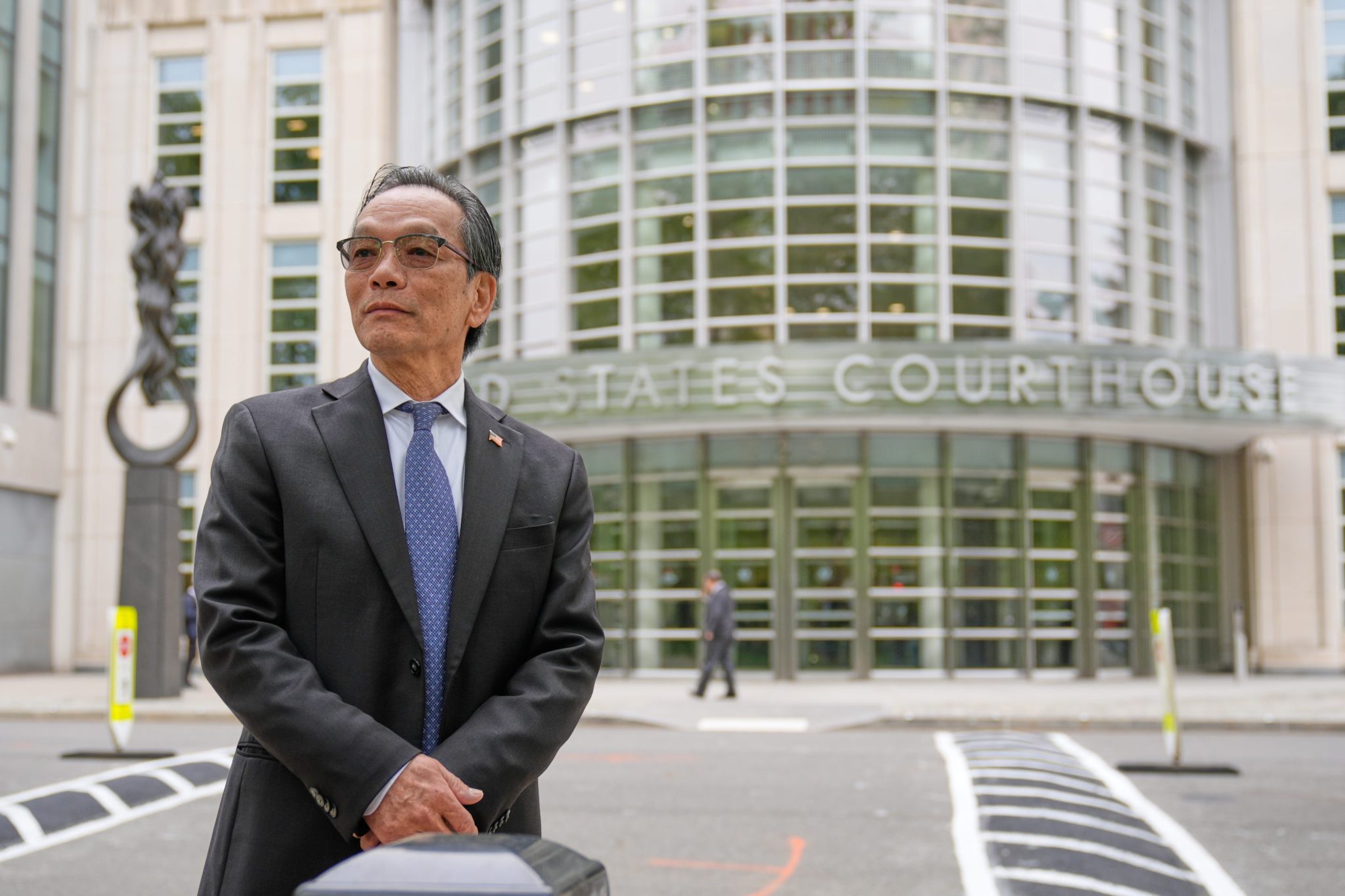
Lu, wearing a dark suit, pale blue tie and glasses, speaks limited English and listened through an earpiece as an interpreter translated Oken and Carman’s words into Fujianese. He and Angwang both had American flag pins affixed to their lapels.
Several dozen supporters, including members of Lu’s church, rallied outside of the courthouse, holding signs with slogans like “Justice for Harry Lu” and “Chinese Americans Are Americans!” and waving small American flags, as Lu and his legal team arrived.
“No one controls him,” Carman told jurors. “If Harry Lu is an agent of anyone, he is an agent for his community — the local people in his community.”
“You have the life of an innocent man in your hands,” the lawyer concluded.
This story was originally featured on Fortune.com