
Budget hawks in Washington have their eyes trained on April 3, when the White House is scheduled to release its fiscal year 2027 budget request, centering on a significant “historic” defense spending increase to $1.5 trillion. The national debt crossed $39 trillion just weeks ago and is alarming figures as varied as Elon Musk and Jerome Powell.
Musk, the world’s richest man and, briefly, an advisor to the White House who was involved with the Department of Government Efficiency before departing in 2025, put it bluntly at a conference appearance last September: “If you look at our national debt, which is insanely high, the interest payments exceed the Defense Department budget—and they keep rising.” His conclusion: “If AI and robots don’t solve our national debt, we’re toast.”
President Donald Trump’s response to this situation is to fix the fact that interest payments exceed military budgets by taking out more debt to boost the military budget, according to a top watchdog calculation.
The Committee for a Responsible Federal Budget (CRFB), a nonpartisan fiscal watchdog, estimated Monday boosting the defense budget by the expected amount would increase total defense discretionary spending by $5.8 trillion from FY 2027 through 2036, and add $6.9 trillion to the national debt once interest costs are factored in. The group noted the projection was revised upward from an earlier estimate owing to an additional year in the budget window and higher prevailing interest rates.
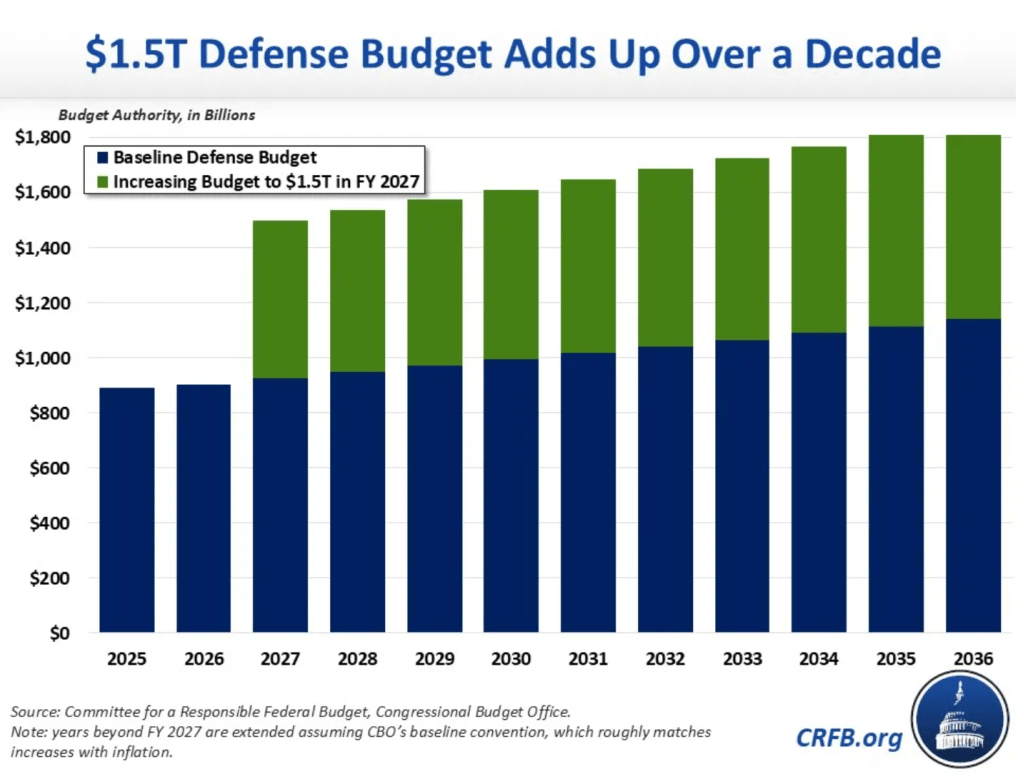
The proposal, which Trump first floated on Truth Social in January, would represent “by far the largest year-over-year increase in defense spending in the post-WWII era,” the CRFB said. The group noted that the request “should be fully offset by other proposals in his budget” and called on lawmakers to reduce other spending, raise revenue, or enact some combination of the two if they wish to accommodate the president’s ask.
On Monday, no less an authority than Federal Reserve Chair Jerome Powell chimed in with similar comments. In a moderated discussion before roughly 400 Harvard economics students, Powell said that while he doesn’t consider the nation’s $39 trillion debt load to be immediately dangerous, its trajectory demands urgent action.
“The level of the debt is not unsustainable,” Powell said, “but the path is not sustainable. It will not end well if we don’t do something fairly soon.”
Powell drew a sharp distinction between the stock of debt and its rate of growth.
“What’s clear is that our debt is growing much faster; the federal government debt is growing substantially faster than our economy,” he said. “And that ratio is going up. And in the long run, that’s kind of the definition of unsustainable.”
The numbers behind Powell’s concern are stark. Net interest payments on the national debt are now projected to exceed $1 trillion in fiscal year 2026—nearly triple the $345 billion the government paid in 2020. In just the first three months of the current fiscal year, interest payments reached $270 billion, already surpassing the nation’s defense spending during the same period. The Congressional Budget Office projects debt held by the public will surge from 101% of GDP today to 120% of GDP by 2036, eclipsing the post–World War II record.
Powell put the ball in Congress’s hands, as to how to solve this issue.
“We don’t have to pay the debt down,” he said. “We just need to have primary balance and begin to have the economy actually growing more quickly than the debt.”
He also acknowledged his warnings about the debt, consistent for roughly a decade serving at the top of the central bank, have historically gone unheeded in Washington: “I pretty much limit myself to those high-level points,” he said, “which essentially everyone ignores.”
Whether Congress will heed the CRFB’s call to offset the defense buildup remains to be seen. But the fiscal arithmetic is unforgiving: Layering nearly $7 trillion in additional debt on top of a $39 trillion base, with interest rates higher than they were just a few years ago, narrows the margin for error considerably—and makes the path Powell warned about much steeper.
This story was originally featured on Fortune.com