
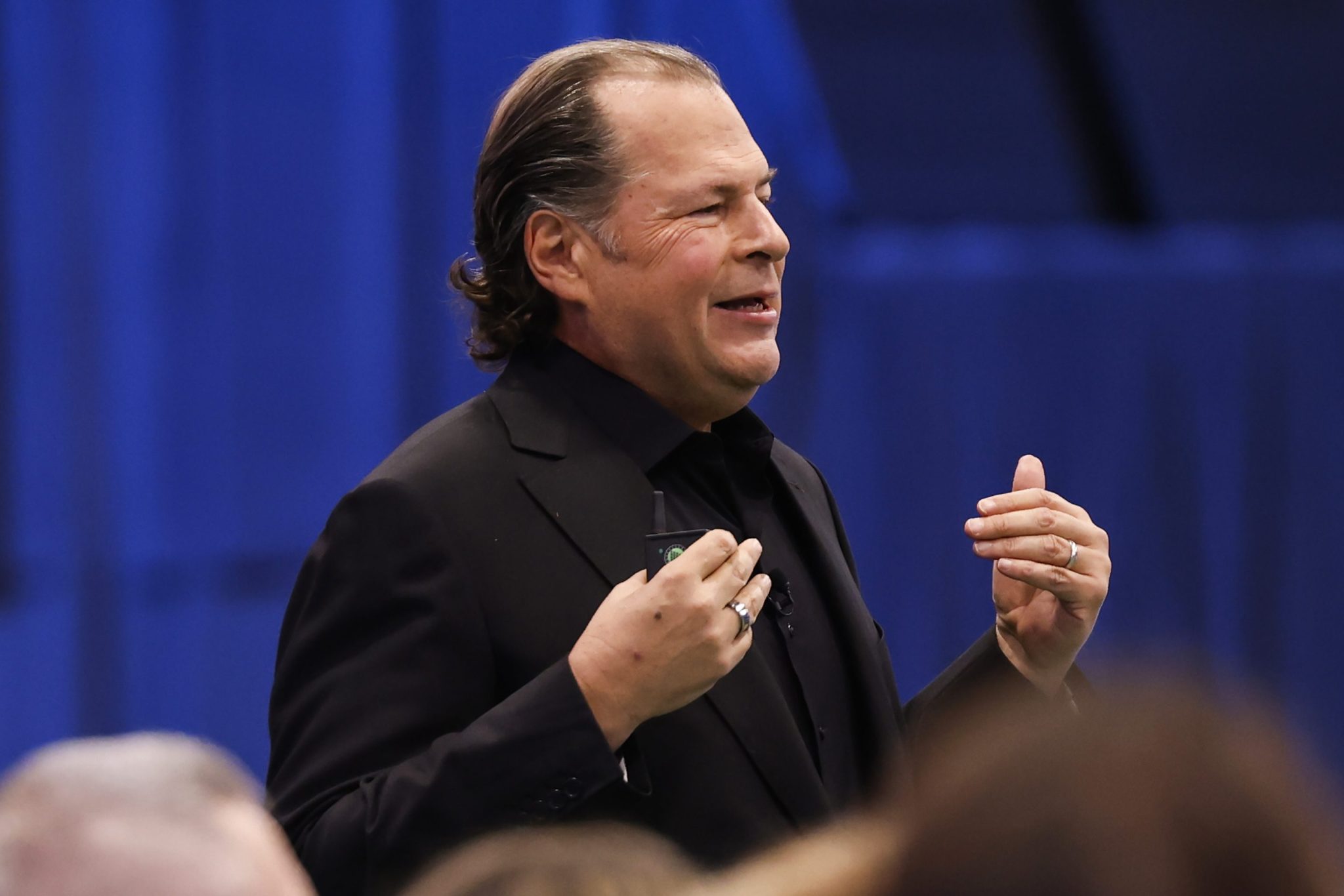
All the world’s a stage. Now that’s even true of the usually dull quarterly earnings call.
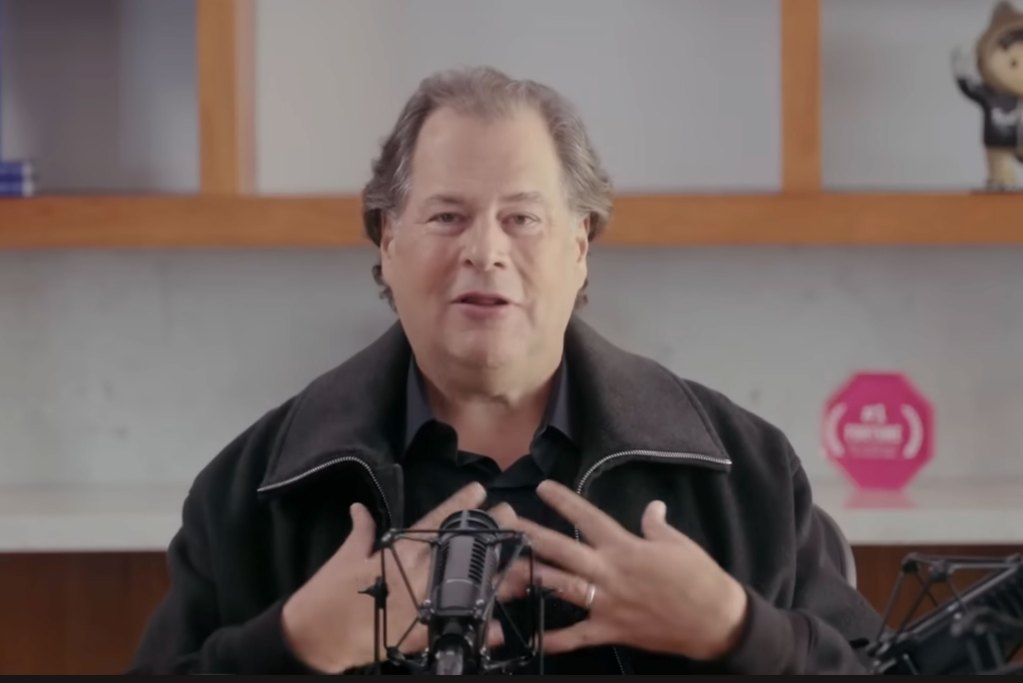
In February, Salesforce founder and co-CEO Marc Benioff turned his routine fourth-quarter earnings call into an influencer-style production. Clad in a black leather jacket and seated high above San Francisco in the Salesforce Tower, Benioff streamed his financial updates like a podcaster, complete with a broadcast-quality microphone, a YouTube livestream, and interviews with special guests, including customers of the cloud-software company such as SharkNinja CEO Mark Barrocas and Wyndham Hotels & Resorts CEO Geoff Ballotti.
“We’re so thrilled to be here with everybody,” Benioff said, seated at a conference table with his colleagues. “It is a gorgeous day, 70 degrees, the AI capital of the world, and we’re coming here to you live.”
Before diving into the numbers, Benioff also made a brief live appearance on TBPN, the daily live podcast about tech that was recently acquired by OpenAI, to tout record revenues and downplay fears of a “SaaSpocalypse,” the selloff that had clobbered the market value of a slew of software companies. Afterward, Salesforce’s social media team sliced the show into a short clip for LinkedIn, extending what used to be a dry, hour-long phone call into snackable content.
“Marc challenged us to try something new and speak to a bigger audience,” Patrick Stokes, president and chief marketing officer at Salesforce, tells Fortune via email, adding that the team wanted to bring some of the “vibe and energy” of its massive annual Dreamforce conference to a standard financial update. The software giant says it plans to use the format again for its first-quarter fiscal year 2027 call in May.
Salesforce’s revamped earnings format comes as companies and boards are increasingly pushing CEOs to be more active on social media. Research from Weber Shandwick found that 81% of executives believe a visible public CEO profile is essential to a company’s reputation, and more than half say it helps attract and retain top talent.
Dreaded by some, dodged by others, and abolished by at least one executive entirely, quarterly earnings calls remain must-listen rituals for Wall Street and the business press, but not for most consumers or even rank‑and‑file employees. Yet as CEOs search for ways to control their own narrative in an era of always-on social media and pressure from artificial intelligence, the once‑stodgy earnings call is morphing into a new kind of corporate performance designed to be watched, clipped, and shared.
An audience-focused space
For decades, the traditional earnings call was a primarily audio-only ritual for Wall Street insiders and reporters, and a box to check off for regulators. Now the same script is being repackaged for employees, customers, and casual scrollers, turning earnings day into another stage for the CEO’s reach.
Benioff’s production was a flashier spin on a format other companies have been building for years. Former T-Mobile CEO John Legere livestreamed earnings calls alongside a panel of executives, all sitting in front of the company’s signature hot-pink branding and decked out in company gear. Palantir has also long used its quarterly YouTube livestreams as a stage for CEO Alex Karp’s unscripted monologues—usually delivered in a casual T-shirt against a plain backdrop—but his wide-ranging reflections are what have turned earnings day into must-watch content for the company’s fervent retail investor base. They consistently rack up tens of thousands of views on YouTube.
“I think Palantir has changed the view of other tech companies [and] how they do calls,” says Dan Ives, a managing director at Wedbush Securities, adding that he expects more companies to follow. “It’s becoming incrementally more important around messaging and the platform and the investor base to not just be some cookie-cutter earnings call where half the people could fall asleep.” He notes the format isn’t a fit for every company or executive, but overall he views the shift as a positive, citing an improved flow of information to investors: “Transparency being improved is better for the stock over time, if companies execute.”
Increasingly, the day a company reports its earnings is also the day its CEO drops a selfie‑style video or LinkedIn essay translating the results for employees and customers. In February, Walmart CEO John Furner shared a short social media video addressed not to analysts but to “associates,” thanking them for serving customers “with speed and excellence around the world.” Airbnb cofounder and CEO Brian Chesky used a similar move following a strong fourth quarter, telling his more than 280,000 LinkedIn followers that Airbnb had a strong quarter, but “the bigger story isn’t the quarter, it’s the momentum,” before walking through hiring, product, and brand decisions.
Benioff is not yet going viral for his Salesforce earning calls: Indeed, for all the glitz, the audience for his hour-long-plus experiment was still modest. According to Salesforce, the livestream drew 2,000 external viewers on virtual meeting platform OpenExchange—a 40% increase in live viewership compared to the previous quarter. On YouTube, the stream earned only 12,000 organic views on a channel with nearly 900,000 subscribers.
LinkedIn editor-in-chief Daniel Roth tells Fortune that more executives are now rethinking how they approach earnings calls to turn a traditionally dry format into dynamic, social-first content. “For decades and decades, the earnings call was the most boring, least innovative thing in the corporate world,” he says. “It was an audio call with a bunch of analysts reading a script.”
Roth argues that companies are sitting on a powerful piece of content they rarely maximize, and it could save time for leaders unable to carve out another hour from their schedules to create social media content. “The executives have the floor, [and] it’s already in the rhythm of how they operate,” he says. “You put so much work into an earnings call. Why not just try to spread it to the world?”
Marcia Newbert, Edelman executive vice president and lead of U.S. corporate digital, says LinkedIn is a “natural channel,” for earnings content, which doesn’t need a mass audience, but rather a focused, niche audience.
“Not every employee or stakeholder is going to tune into an earnings call; that’s a very specific audience,” she says. “But more are paying attention online.”
The celebrity CEO
It’s no secret that many CEOs loathe quarterly earnings calls. The tedious ritual of corporate life has drawn many gripes and grievances from chief executives stemming from frustrating short-term conversations to tough “gotcha” questions to small missteps that can cause catastrophic market volatility.
To prevent the drama, some executives, including Amazon founder and former CEO Jeff Bezos, avoid making appearances or lean heavily on their chief financial officer to field questions. Others increasingly would prefer to turn over the conversation to AI entirely.
In 2023, Disney CEO Bob Iger joked he wouldn’t mind AI replacing him on earnings calls, quipping, “You probably wouldn’t know the difference.” In 2025, Klarna CEO Sebastian Siemiatkowski allowed his unblinking AI avatar to present highlights from the first-quarter earnings. More recently, Zoom CEO Eric Yuan told the WSJ Leadership Institute he dislikes traditional quarterly earnings calls so much, he is now using an AI “digital twin” to present scripted remarks, and joins only for the live Q&A. “I needed to either record a script or read a script,” he said. “I hate that. I do not like it.”
The format is opposed by so many executives that the U.S. Securities and Exchange Commission on Tuesday submitted a proposal to throw out the requirement and give companies the option to share results twice a year instead of four times. While the proposal has drawn support from the likes of JPMorgan Chase, it has been met with a strong reaction from a cohort of institutional investors and hedge funds—including billionaire Ken Griffin’s Citadel—which argue that the quarterly reporting mandate keeps key financial information flowing for investors in public companies.
It’s possible that the podcast format for earnings calls will reduce opportunities for the tough questioning from the analysts that hold company leaders’ feet to the fire. Still, their companies’ audience engagement teams are eager to delve into the institution of the earnings call. Mining the earnings call for additional content can be a simple way for executives to solve both business and company culture goals. And behind the blinding ring lights and flimsy clip-on microphones, there’s a real return on investment for businesses and leaders: A humanistic approach could serve to charm shareholders, win over younger customers, and connect with employees. Research from FTI Consulting, for example, found that 92% of professionals say they are more likely to trust a company whose senior leaders are active on social media.
The extroverted CEO is not new. Apple’s Steve Jobs, Chrysler’s Lee Iacocca, and Mary Kay Cosmetics founder Mary Kay Ash all turned corporate leadership into a performance long before LinkedIn existed. But while Jobs gave a handful of keynotes a year, today’s chief executives are expected to produce a near-constant stream of content or risk losing the attention of their audiences.
This article is part of the May 6 2026, Special Digital Issue of Fortune.
This story was originally featured on Fortune.com