
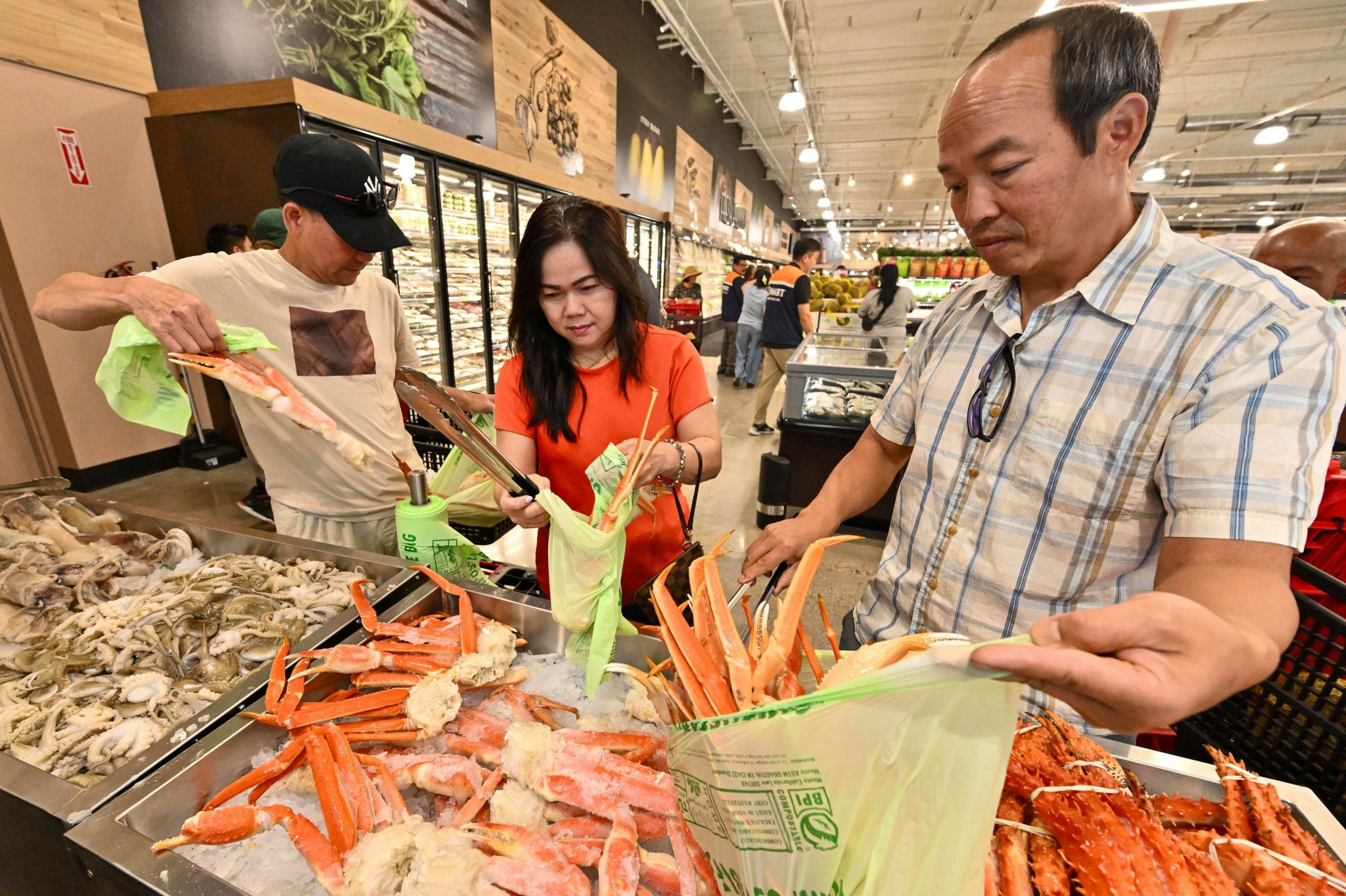
It’s a perplexing time in the world of luxury ingredients. Prestigious products have become inextricably tied to fast food. Caviar now adorns chicken nuggets; truffle features in supermarket hummus and Starbucks egg bites; wagyu beef is getting smashed into burgers and has made the menu at Burger King in the UK. Even lobster—bright red and festive—has gone from attention-getting centerpiece to mac-and-cheese mix-in.
Yet crab retains its mystique. It’s beloved for its delicately flavored, finely textured meat—and for its fatty, rich roe and tomalley, culinary categories unto themselves. Now large, live specimens from the far corners of the world, like snow crab from Japan and red king crab from Norway, are this season’s luxury signifiers.
“Even the cheapest crab that we sell is typically double the price of what Maine or Nova Scotia lobster costs,” says Ian Purkayastha, founder of Regalis Foods. “King crab pricing is definitely at an all-time high.” Because their stocks and availability have been harshly affected by political and ecological upheavals, the crustaceans now wholesale for $70 to $85 a pound, he said. Retail consumers could spend upward of $1,200 to have a single, live 10-pound Norwegian red king crab delivered to their homes from Regalis. That, believe it or not, is the good news, he adds: “It’s just going to continue to go up and up and up in price. It’s not like you can farm a king crab.” He won’t be surprised if wholesale king crab prices top $100 a pound within five years.
The $888 Menu
Take stock of current splurge-worthy dishes and dinners, and you’ll see: American diners and restaurant operators are embracing the luxury of crab. With the explosion of omakase-style dining, quality is trumping quantity more than ever. Take, for instance, Sushidokoro Mekumi. Newly opened in New York’s Hudson Square, this outpost of a two-Michelin-star restaurant in Kanazawa, on Japan’s west coast, offers a crab-centric omakase dinner for $888 per person, excluding drinks, for a few weeks this winter.
The meal’s current star is male snow crab, transported from Kanaiwa, a port town in Ishikawa prefecture, to New York in two days, at a wholesale cost of as much as $675 each. Three are needed for each evening’s seating of eight people. All December seatings are sold out, but January spots are available.
Mekumi’s chef Hajime Kumabe keeps it simple to convey just how good the ingredient is: “We almost never add anything else—just a little salt as seasoning.” Among the 18 to 20 courses are kani gayu, a delicate rice porridge made only from crab, crab broth, rice and salt; mokuzugani, or Japanese mitten crab, simply grilled over binchotan charcoal; and kobako gani, a female snow crab boiled immediately after it’s caught by fishermen in Japan, trained to do it to the restaurant’s specifications. Its meat is arranged with both its internal and external roe and served in its shell.
(An even more precious, and expensive, crab will splash into New York at the end of the year. Taiza gani, a snow crab from the cold waters off Kyoto is so rare that even in Japan it’s known as the “phantom crab.” Only five boats are permitted to fish it. It will be served for two nights at the new Tribeca kaiseki restaurant Muku; the $1,295 menus quickly sold out.)
Crab’s preciousness doesn’t just stem from its pristine state or the distance it’s traveled; it’s also in the labor it takes to bring it to the plate. At Yamada, the New York kaiseki restaurant that just scored four stars from the New York Times, it can take chefs 45 minutes of concentrated work to extract the meat from just one 2-pound kegani, or horsehair crab—just one of the crustaceans likely to appear in its $295, 10-course early winter menu. You might also find Hokkaido snow crab on the chawanmushi, a savory egg custard, and Dungeness crab in the closing donabe course.
The $100 Rice
Outside New York, crab features at the twice-a-week kaiseki-inspired Crab Experience at Kinkan, a Thai-Japanese restaurant in Los Angeles. “Crab is my favorite thing,” says chef-owner Nan Yimcharoen, who grew up cooking and eating it with her grandmother in Bangkok. Over the course of the 11-course, $250 dinner, she serves dishes like sake steamed live Hanasaki gani—a spiny king crab from Hokkaido—and open-face scallop-shrimp shumai, topped with snow crab and sawagani, a tiny Japanese river crab, fried and eaten whole.
At Angler, the live-fire seafood restaurant on San Francisco’s Embarcadero, savvy diners know to order the $100 off-menu crab rice. The course is composed of two dishes; a crab shell filled with the meat covered in Angler’s XO sauce, and koshihikari seaweed rice with crab butter, sake-cured salmon roe and crispy garlic chips. The crab variety changes seasonally and with the day’s catch: King crab is on the horizon; box and Dungeness crabs have featured recently. (If they can’t get good ones from California’s waters, the dish just isn’t available.)
Dungeness, which James Beard called “a meal that the gods intended only for the pure in palate,” is also a marquee attraction (and the highest priced menu item) at two of the country’s notable regional Indian restaurants. At Unapologetic Foods’ Semma in New York’s West Village, diners are advised to preorder the $145 Kanyakumari Nandu Masala for two, which features a 1- to 1.5-pound crab cooked with cumin, black pepper, coriander seeds “and other spices too numerous to mention,” says chef Vijay Kumar.
The crab comes with coconut rice and crisp-edged parotta, for sauce sopping and textural contrast to the silky crabmeat. (Crab is an obsession across Unapologetic Foods’ restaurants.) Meanwhile at Nadu, chef Sujan Sarkar’s new Chicago restaurant, about 15 diners per week order the Keralan Crab Milagu Fry, available in big and bigger sizes for $135 and $185. For it, a whole Dungeness crab is cooked with Tellicherry peppercorn-tomato sauce and served with ghee rice.
The $2,000 Crab Deal
And then there’s the ceremony around live king crab. This fall at Octo, a Korean-Chinese restaurant in midtown New York, Steve and Christina Jang (owners of nearby Koreatown stalwart New Wonjo BBQ) began offering a feast featuring the creature in three parts: steamed with butter, garlic, soy sauce, cabbage and mushrooms over vermicelli noodles; dry-fried Sichuan style; and as fried rice, with the tomalley. An 8-pound crab, enough for five or six people, recently went for $850, they said, adding that they’re keeping the price low while they get the word out.
At Carbone Riviera, which opened in the Bellagio, Las Vegas, in November, food has to work overtime to compete with flash: along with artworks by Miró, Picasso and Renoir, the restaurant has Fortuna, a 33-foot-long Riva yacht to give select guests a better view of the hotel’s famous fountains.
The restaurant’s king crab might just be the crustacean for the job. It comes prepared “Mulberry Style,” to reflect the abundant Italian and Chinese flavors on Mulberry Street, running through New York’s Little Italy and Chinatown. Priced from $175 to $200 per pound, a large one could tip the scales at upwards of $2,000. It is, potentially, the most expensive item at a place that is, for many people, what luxury is all about.
This story was originally featured on Fortune.com