
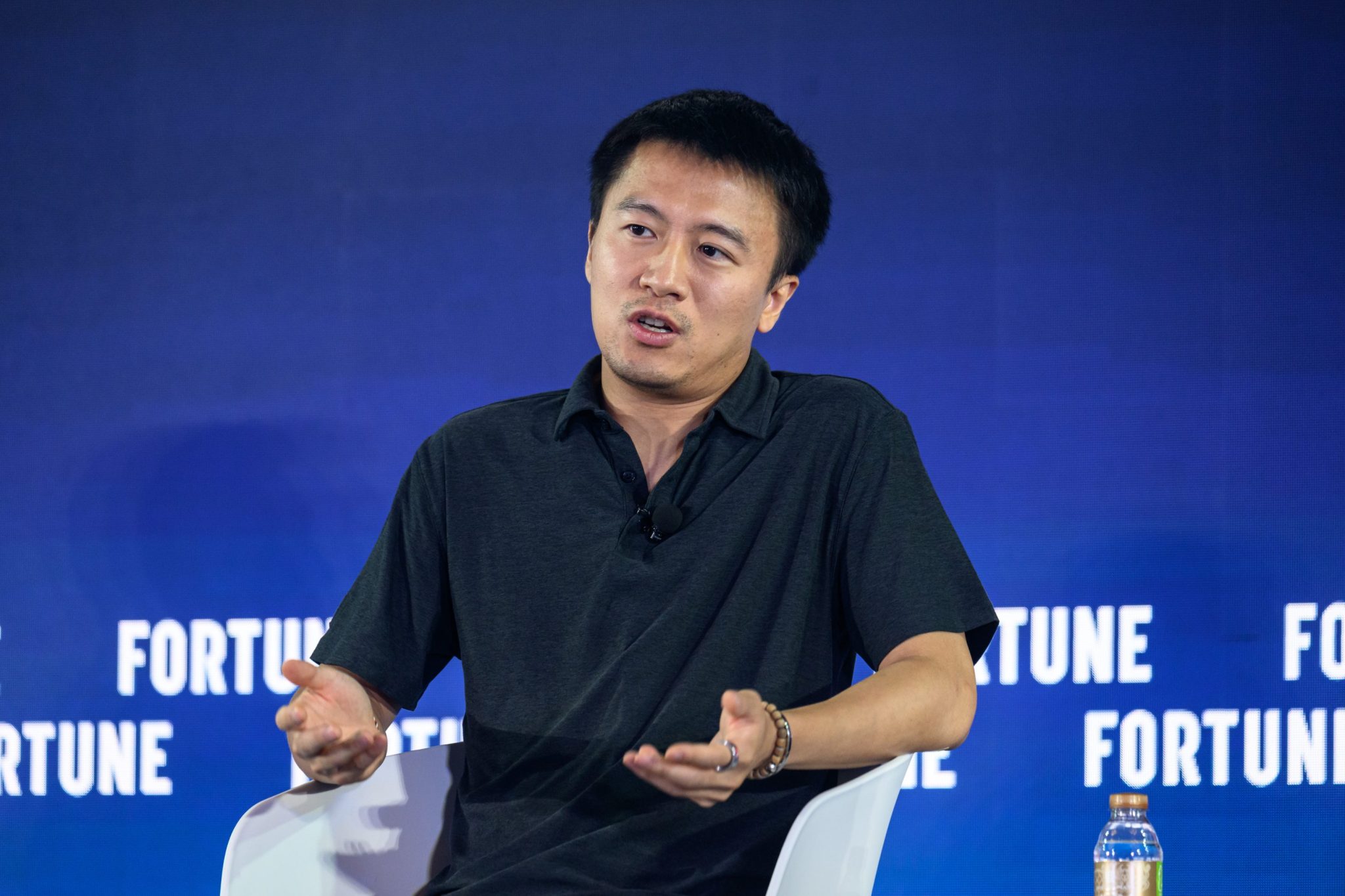
When Yuxiang Zhou, founder of Black Lake Technologies, pitted an AI sales coach against his company’s most experienced sales leader, seven out of 10 of Black Lake’s most senior salespeople voted for the machine’s advice.
The experiment began when Zhou complained that his CRM software reduced a day of client conversations to “a very subjective one paragraph, and then the leader sits back and reads this paragraph and analyzes.”
So his company, a Shanghai-based startup that supplies AI agents to factories across Asia, gave its salespeople a pin that recorded their conversations and location. These conversations were fed into an AI agent trained to act like a coach.
“A lot of people use AI as a way to co-pilot the leadership, but I’m trying to explore the way of me co-piloting the AI,” Zhou said at the Fortune Leaders Forum in Macau on Sept. 8. “A lot of my decisions are now made by agents, large language models, and my executives.”
Still, human salespeople have their place. Agents are “emotionless,” Zhou noted, and sales teams still need to be motivated—something only a person can do.
Zhou was one of three panelists at the Forum discussing how a corporate executive’s role needs to change if AI can handle reasoning and execution.
For Becca Carroll, chief strategy officer at design agency IDEO, speed isn’t enough to build a moat against competition. Being the first to market, or even the first to follow some new innovation, won’t be enough to create a “durable” advantage. “Once you dream of something, your competitors could roll it out to market the next day, or two weeks later,” she said.
Carroll also updated IDEO’s famous concept of the “T-shaped person”—deep expertise in one discipline, popularized by former CEO Tim Brown—with a new archetype: the “comb-shaped” person, someone who is “almost polymathic, someone who has depth of expertise across a series of disciplines and can fluidly move between them.”
James Arnett, Wipro’s managing director for Southeast Asia, Greater China, and South Korea, put the same shift in leadership terms: “The big shift is…from directing to orchestrating.” Wipro, he said, has moved “way past” the question of how AI can save clients money, and is now asking how to redesign what it offers from scratch.
All panelists agreed that the constraint isn’t technology, but people, whether that’s employees, customers, or even executives themselves. “A lot of the time, we can see that AI can do something—but is the organization ready for it?” Arnett said.
Carroll added that “we can change technology all we want, but we need to move at the speed of trust… It’s not just a question of what technology we can adopt and be done, but what’s the trust journey we are designing in service of our bigger vision.”
Even Zhou, for all his experiments, is waiting for AI’s true inflection point. “I’m still looking for the Google moment for AI,” he said. “I don’t think it has happened yet.”
In part to find that answer, Black Lake is testing a new platform that uses AI to turn an idea from a celebrity into manufactured merchandise that can cut the minimum order for custom collectibles from 10,000 pieces to 100.
“I think the real Google moment should happen only when you restructure the industry rather than replace human beings,” he said.
This story was originally featured on Fortune.com