
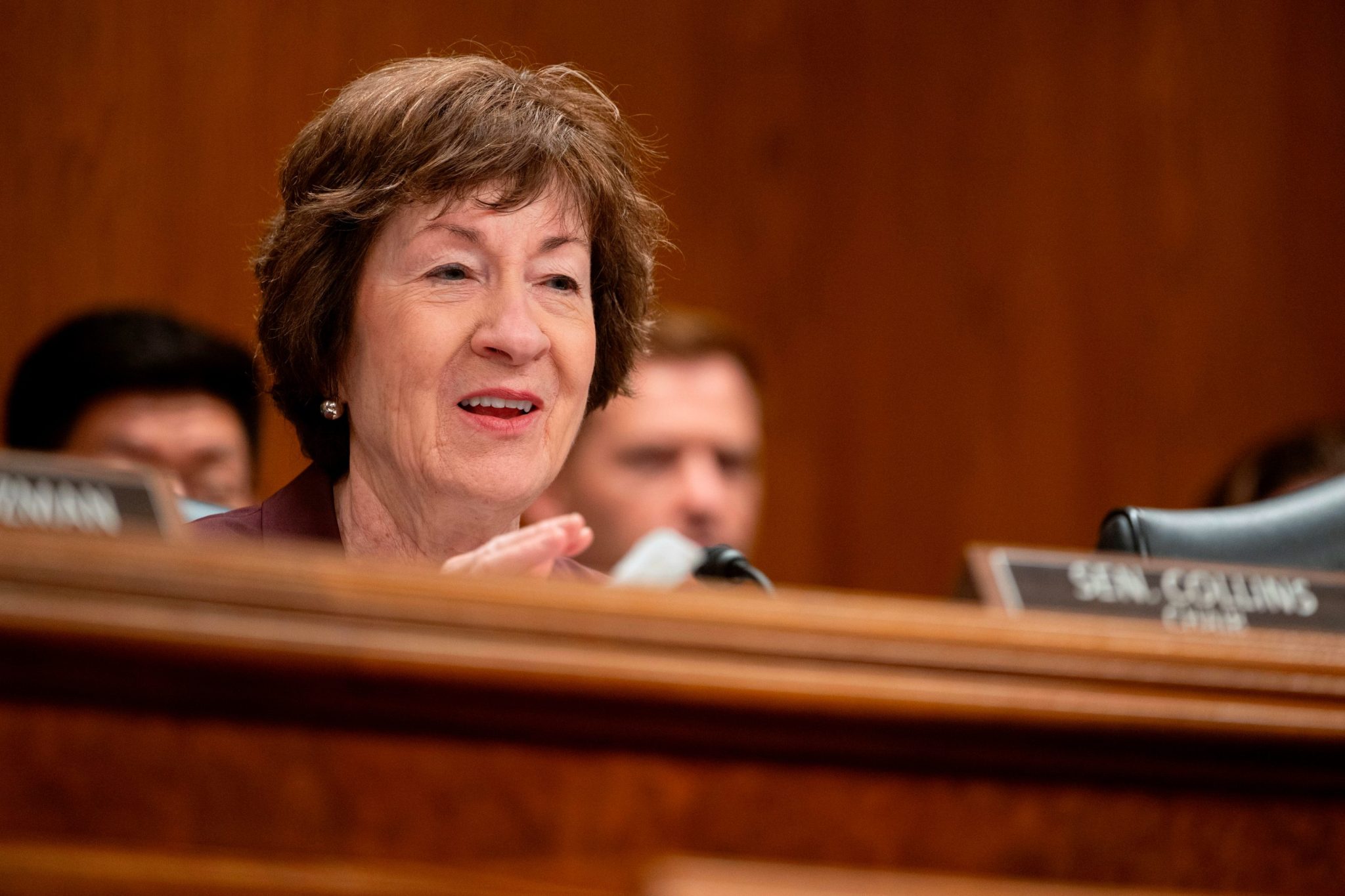
Republican U.S. Sen. Susan Collins says she has a benign essential tremor, disclosing the longtime health condition for the first time in her decades-long political career as she seeks reelection in one of this year’s toughest Senate races.
Collins first confirmed the tremor to WCSH-TV in Maine on Wednesday after facing questions about her health from appearances in recent videos, including her campaign announcement video.
The condition causes trembling in Collins’ hands, head and voice, and she said she has had it for the entirety of her nearly three-decade Senate career. It affects millions of Americans over the age of 40 and “does not interfere” with work, Collins said in a Thursday statement to The Associated Press. She said it is not a neurodegenerative condition.
“The tremor is occasionally inconvenient, and sometimes the subject of cruel comments online, but it does not hinder my ability to work and, as I said, is something that I have lived with for decades,” the statement said.
Health issues and candidates’ ages have drawn increased scrutiny in high-profile elections following Democratic President Joe Biden’s decision not to seek reelection in 2024 at age 81. Those questions have only lingered with Republican President Donald Trump, who’s 79 and in recent months has been seen with bruising on the back of his hand, sometimes concealed with makeup. The White House acknowledged last year that Trump was diagnosed with chronic venous insufficiency.
Collins is up for reelection in a seat Democrats need to flip to have a chance to take back the Senate. Her likely opponent is Democrat Graham Platner, an oyster farmer and combat veteran, after Democratic Gov. Janet Mills suspended her campaign last week. Age has been an issue in the contest, with Collins, 73, and Mills, 78, more than three decades older than Platner, 41.
Platner acknowledged early in his campaign his own health problems. He has spoken openly about chronic pain in his shoulder and knees stemming from combat service, and he has said he was diagnosed with post-traumatic stress disorder after serving at war. Platner has said he has a 100% disability rating from the U.S. Department of Veterans Affairs but continues to work as an oyster farmer.
“There are a lot of disabled combat veterans, or just disabled vets, at 100%, who still work,” Platner told WCSH last year. “It’s a very normal thing.”
Collins was first elected to the Senate in 1996 and said in her statement that she has had the condition for all of that time. Over the years, the condition has been noticeable in Collins’ debates and frequent public appearances.
As chair of the Senate Appropriations Committee, Collins has been at the forefront of the chamber’s many spending disputes this Congress, often leading the floor debate and providing the GOP’s closing arguments. She frequently engages with reporters in the hallways. Her streak of never missing a Senate vote is up to 9,966 and stands as the second-longest consecutive voting streak in the chamber’s history.
Tremors happen when nerves aren’t properly communicating with certain muscles. Essential tremor, sometimes called benign essential tremor, is one of the most common movement disorders, according to the National Institutes of Health.
The risk of developing it increases as people get older, but at least half of cases are inherited, meaning the tremor runs in the family, and those tend to begin at younger ages. It almost always involves shaky or trembling hands but also can affect the head, voice or lower limbs.
___
Kruesi reported from Providence, R.I. Associated Press writers Kevin Freking and Lauran Neergaard in Washington contributed to this report.
This story was originally featured on Fortune.com