
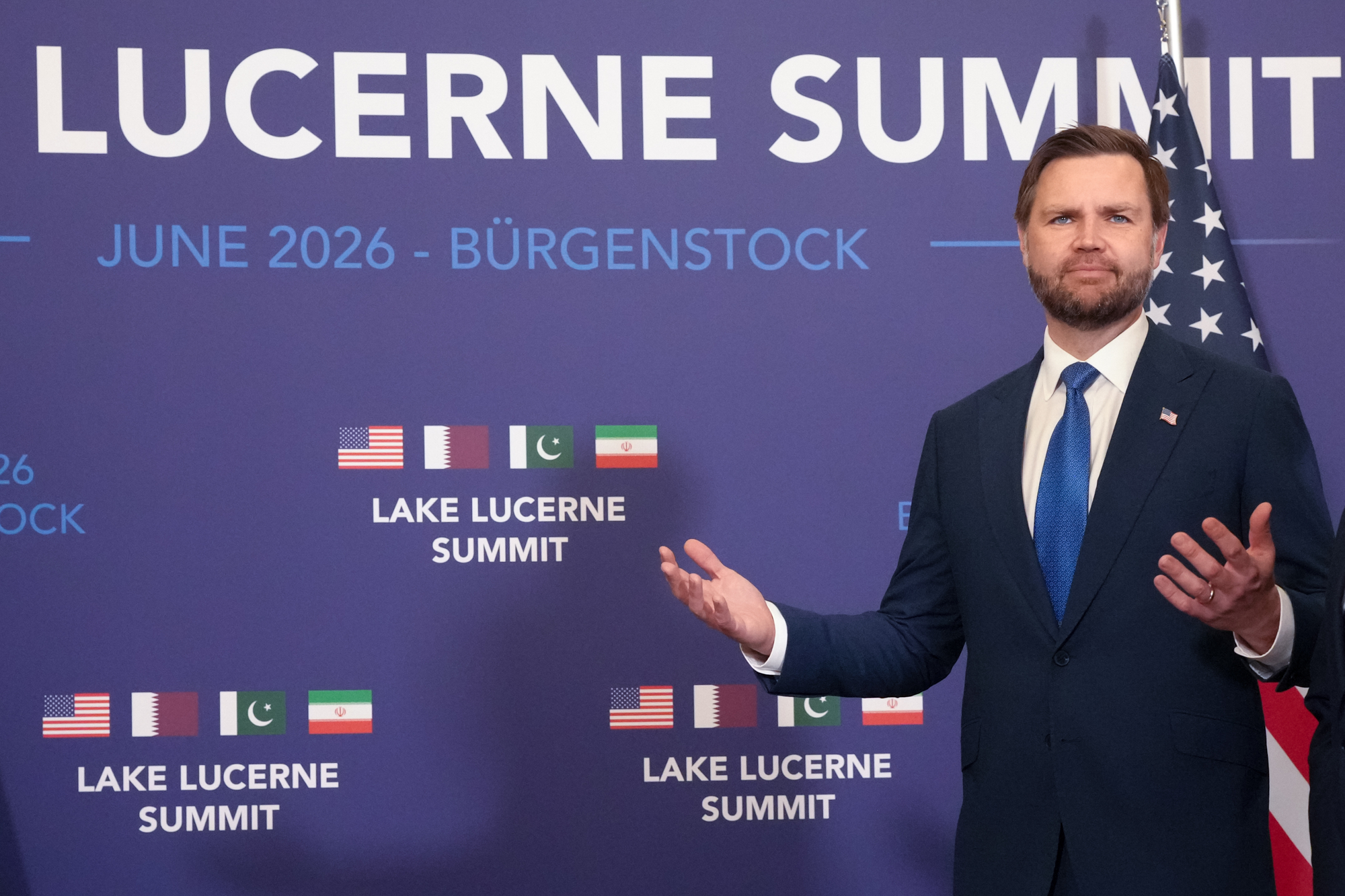
High-level U.S.-Iran talks on their interim deal to end the war had a tense start Sunday in Switzerland as Tehran took offense at comments by President Donald Trump, who threatened to attack and told Iran’s president to watch what he says.
The comments from afar — on social media and to news outlets — complicated efforts by Vice President JD Vance and mediators Pakistan and Qatar to keep Iran engaged in discussions meant to address thorny issues like Tehran’s nuclear program, the Strait of Hormuz and the unfreezing of billions of dollars in Iranian assets.
Before anything, however, Iran wants to discuss Lebanon, where Israel’s military has been fighting the Iranian-backed Hezbollah militant group, since the deal halts conflict on all fronts.
“Iran must immediately stop their highly paid PROXIES in Lebanon from causing trouble,” Trump said on social media. “If they don’t, we’ll hit Iran very hard again, just like we did last week, only harder!!!”
“They would do better to be careful about their statements,” Iran’s lead negotiator, Mohammad Bagher Qalibaf, said on X after Trump’s comments. “Our armed forces are prepared to respond to them in a different manner. They may keep talking, it is we who act.”
Iranian state media said talks had entered a “difficult phase” and recessed after the “publication of an insulting message by the U.S. President.” The Iranian delegation then met with Qatari mediators and left the negotiating site, state media said.
Vance and U.S. negotiators including Steve Witkoff and Jared Kushner, Trump’s son-in-law, had met with Qalibaf and Foreign Minister Abbas Araghchi for what Iranian state media said was about 80 minutes.
An official with knowledge of the talks later told the AP the Iranian delegation remained engaged in the talks and has not indicated to mediators any intention to leave. The official requested anonymity due to the sensitivity of the talks.
Iran first wants to focus on Israeli strikes in Lebanon
Negotiators are in a 60-day sprint to reach an agreement on the technical details that hold massive implications for the world economy and global security.
“The question before us now is how much more can we accomplish together? Can we turn over a new leaf?” Vance said as the talks began, and asked whether they could “change relations in the Middle East permanently.”
The U.S. wants Iran locked into negotiations over its nuclear program amid concerns it may be used for military purposes, which Iran denies. Vance also wants Tehran to commit to keeping open the Strait of Hormuz, which Iran on Saturday claimed to close. The U.S. has disputed that, saying shipping traffic continued Sunday.
But Iranian Foreign Ministry spokesperson Esmail Baghaei told the state news agency that Tehran first wants talks to focus on the conflict in Lebanon.
A renewed ceasefire in Lebanon, brokered on Saturday, appeared to be holding, and Israel’s military said it would lift movement restrictions for residents near the border with Lebanon on Monday morning — another sign of calm.
But neither Israel nor Hezbollah is a signatory to the U.S.-Iran deal, and Israeli Prime Minister Benjamin Netanyahu has vowed to keep his forces in southern Lebanon until any threat to Israel is eliminated. Hezbollah has refused to halt attacks unless Israel commits to withdrawing.
Sharp words are exchanged over Iran’s nuclear program
The agreement signed by Trump and Iranian President Masoud Pezeshkian immediately allows Tehran to sell its oil freely and paves the way for Iran to tap into billions of dollars in assets that are currently frozen.
It also calls for Iran to dilute its stockpile of highly enriched uranium, believed to be buried under nuclear sites that were targeted in U.S. strikes a year ago.
Pezeshkian, however, declared Sunday that “we will never back down from the right to enrich uranium, and the other side is also forced to accept it,” according to Iran’s state media.
Trump, in a telephone interview with Fox News, later warned that the Iranian president should watch what he says and threatened to take over Iran, in comments relayed by a Fox correspondent.
Iran had cautiously approached the talks given its previous experience with U.S. negotiations on the nuclear issue, which twice in the past year were interrupted by military strikes.
The deal has stirred much controversy
Vance has said he planned to be in Switzerland for “a day or two,” leaving much of the detailed negotiations to be led by Witkoff and Kushner. His role in the talks has heightened scrutiny at a time when he’s considering a 2028 presidential campaign.
Trump and Vance have come under searing criticism from parts of their own party for the deal, with Republican hard-liners unfavorably likening it to the nuclear agreement signed by the Obama administration that Trump and Republicans have insisted did nothing to terminate Iran’s nuclear program.
The new agreement says commercial vessels can pass through the Strait of Hormuz for 60 days without charge, but does not preclude future fees imposed by Iran. Trump made his own threat Saturday to levy U.S. tolls if there is no deal with Iran in 60 days, insisting that the money would be for “services rendered as the Guardian Angel to the countries of the Middle East.”
The Trump administration has been working to reassure global markets that the war has been merely a blip on oil prices, as Americans complain about high gasoline prices ahead of peak summer travel. After the deal was announced, oil futures dropped almost 8%.
Markets are expected to closely track the progress of talks when they open for trading Sunday evening.
This story was originally featured on Fortune.com