

Surveys consistently show that workers dread artificial intelligence. They worry it will render their skills obsolete, hollow out their roles, and eventually eliminate their paychecks altogether. That anxiety has shaped public discourse, union bargaining tables, and congressional hearings for the better part of three years. But a sweeping new analysis from Morgan Stanley Research offers a finding that cuts against the fear — and quietly illuminates something far more consequential about how AI is reshaping the American economy.
AI isn’t destroying jobs. It’s making workers dramatically more productive. And the workers are doing that extra production? They have no idea.
The numbers that should calm everyone down
The Morgan Stanley report, authored by Chief U.S. Economist Michael Gapen and a team of economists, examined industry-level output per employee across the U.S. economy and cross-referenced it with each industry’s degree of AI exposure. The results were striking: industries classified in the top quartile of AI exposure contributed 1.7 percentage points to the overall 2.4 percentage-point growth in productivity recorded over the four quarters through the end of 2025. A year earlier, those same industries had contributed just 0.7 percentage points. The acceleration is not subtle.
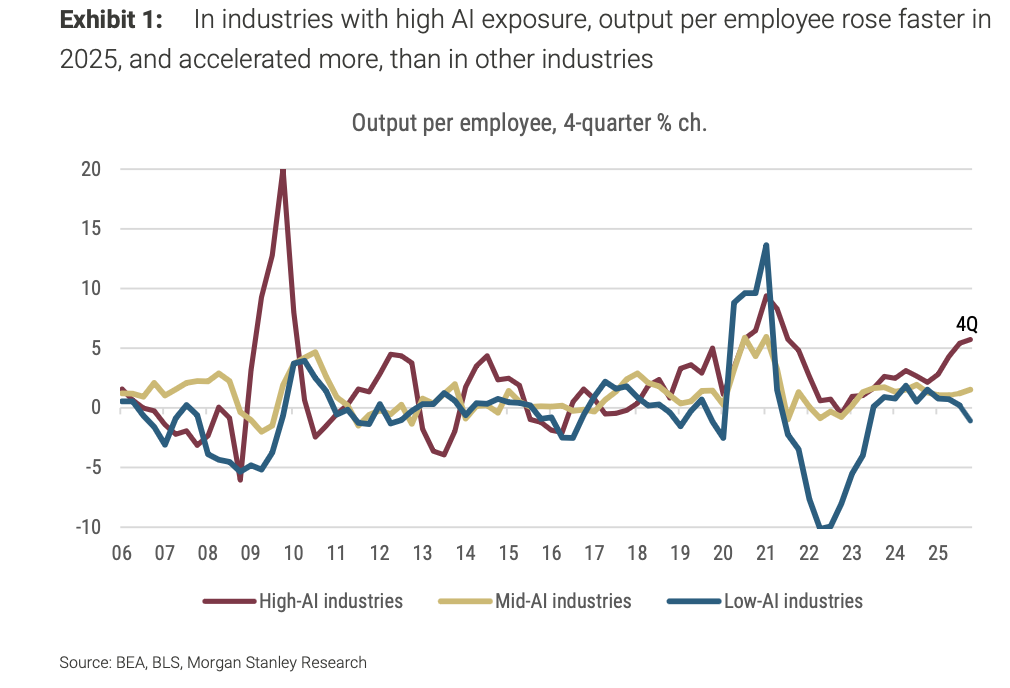
Here’s what makes the finding particularly revealing: that surge in productivity wasn’t produced by cutting headcounts. Employment trends across high-, medium-, and low-AI industries were broadly similar. What differed was output — how much those workers were producing. In high-AI industries, output accelerated sharply while employment growth stagnated. In low-AI industries, output actually slowed.
In economic terms, this appears to be a best-case scenario unfolding in real time: workers are not being displaced; they are being augmented. But psychologically and culturally, it creates a paradox. The workforce’s hatred of AI may look, from the outside, like a failure of economic literacy. Workers are thriving and don’t know it. Look closer, and a more sophisticated fear comes into view — one that the productivity data doesn’t address at all.
The 90% problem
But aggregate productivity numbers obscure a brutal internal sorting that is already underway inside companies. Tech executive and AI strategist Daniel Miessler, whose observations on the workforce have circulated widely in recent weeks, argued in a LinkedIn post that the real dynamic isn’t AI replacing workers — it’s AI allowing a small tier of top performers to absorb the work of everyone below them.
“AI can’t come anywhere close to replacing the top performers at a big company,” Miessler wrote. “But they’re spending millions a year on tens of thousands of employees in the bottom 75%… companies no longer want to pay millions a year for mediocre employees. They’d rather fire everyone but the best, and have them become 10x or 100x what they were by wielding AI.” The productivity boom, in this reading, isn’t lifting all boats. It’s concentrating leverage at the top while quietly marking a much larger cohort for displacement — not by machines directly, but by a smaller number of humans wielding them. An even darker outcome is whether those top 10% workers are just buying themselves a few more years before they’re displaced, too.
The AI tools driving this boom, technologist Shaun Warman pointed out in a recent blog post, are not priced at their actual cost. A serious individual user of a frontier model consumes roughly $80 to $150 of compute per month at real prices; the subscription that buys it runs $20. OpenAI has acknowledged publicly that even its $200-a-month enterprise tier loses money on its heaviest users. The reason for the subsidy, according to Warman, is simple and unsettling: “The user is not yet the customer. The user is the training set.” Every edit, regeneration, and follow-up question a worker fires into a frontier model is training data, aggregated across hundreds of millions of users and tens of billions of conversations.
“Synthetic data has crossed the quality threshold,” Warman argued. “Models can now generate, filter, and grade their own training data at a level competitive with raw human input. The frontier labs publish papers on this monthly.” The straightforward implication, he concluded, is that “the marginal value of a human edit is falling as the model’s ability to produce its own corrections rises.”
What happens when the subsidy ends?
Warman identified three forces that will close what he calls “the apprenticeship window” within three to five years: the aforementioned quality threshold; agentic self-play, allowing models to evaluate and improve themselves in domains with verifiable outcomes; and sheer scale, meaning that additional human feedback is hitting diminishing returns. When those forces converge, the subsidy that makes AI accessible to ordinary workers will lose its justification.
Warman’s predictions for what follows are stark: the $20 monthly tier will vanish or degrade into an advertising-supported shadow product; top capabilities get gated behind enterprise contracts with five-figure annual minimums; and in the most extreme scenario, the labs stop licensing AI as a tool altogether and simply become the operator — law firms, consulting shops, hedge funds — capturing the economic value themselves rather than sharing it.
The productivity data, in other words, is a snapshot of the apprenticeship phase — a period when workers’ and labs’ interests align almost perfectly. Both want better output. For now, both get it cheaply.
The Morgan Stanley economists note, carefully, that the pattern of rising output and stable employment “may change as AI adoption picks up.” That hedge deserves more weight than it typically receives — because the repricing, when it arrives, will not affect all workers equally. Large enterprises that can amortize six-figure AI contracts across thousands of employees will barely notice the transition. Workers at smaller firms, in lower-margin industries, or in the public sector — teachers, healthcare aides, municipal workers — face a starker calculus: the tools that made them more productive were priced below cost as a temporary subsidy, and the bill, when it comes, will be set by what large corporations are willing to pay, not what individual workers can absorb. The productivity gains currently showing up in the data may accrue broadly. The tools that generated them may no longer be broadly accessible.
Workers aren’t wrong to be wary of AI. They may just be sensing the right threat at the wrong moment — not the displacement that’s being measured, but the repricing that isn’t yet.
For this story, Fortune journalists used generative AI as a research tool. An editor verified the accuracy of the information before publishing.
This story was originally featured on Fortune.com