
Artificial intelligence? It’s no mere tool, but a capability. And just like a superhero discovering their powers for the first time, you can’t expect an employee or organization to master that newfound capability without rethinking everything—and making a bit of a mess along the way.
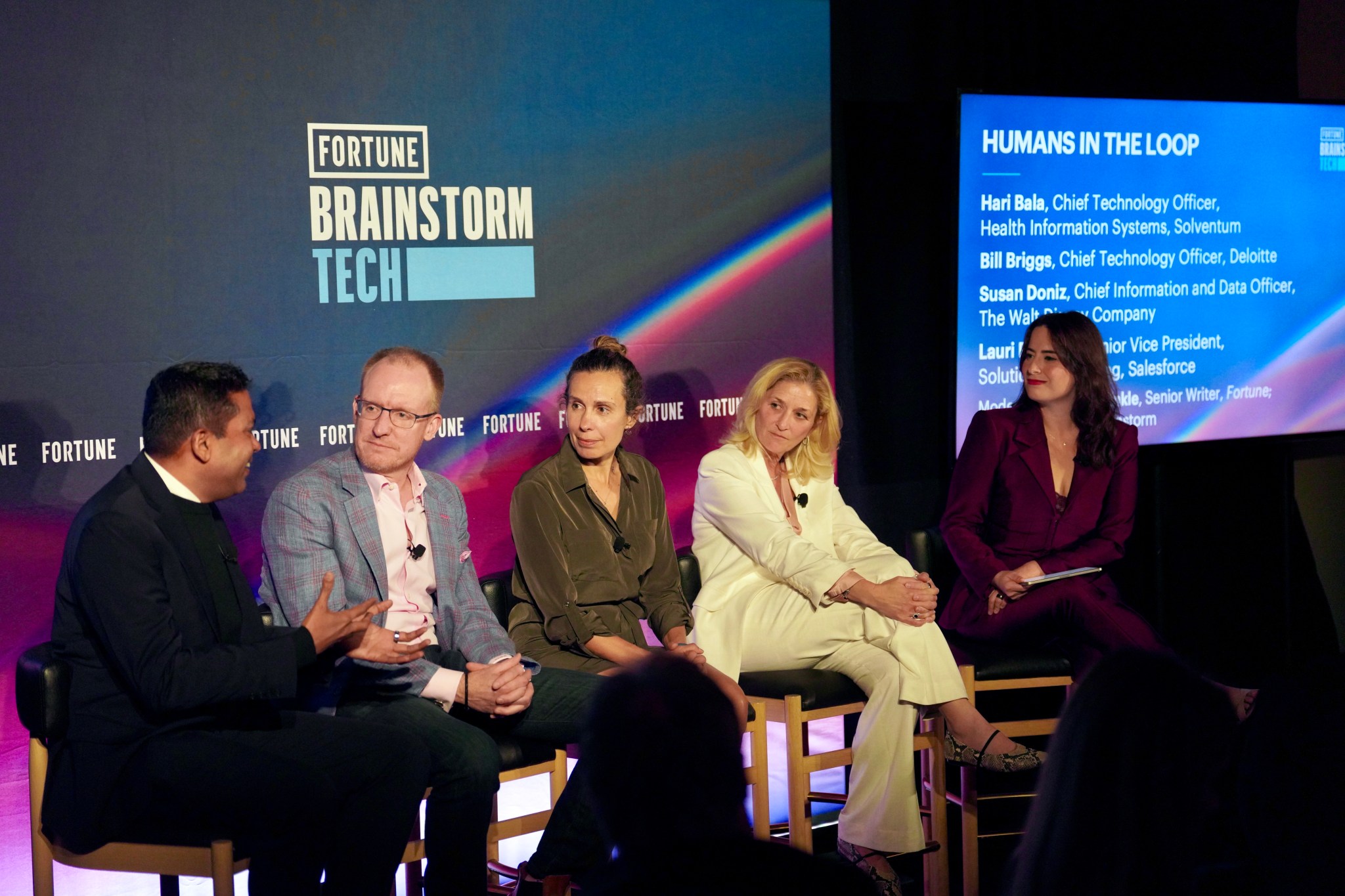
At the annual Fortune Brainstorm Tech dinner during CES in Las Vegas, a panel of senior technology executives deliberated the nuances of AI-driven change management—and in particular, where humans must remain “in the loop” as agentic AI sweeps across the corporate world.
“[With] any technology adoption, it’s tempting to … [take] the things we’ve always done and see how we can do it a little bit differently and a little bit better,” said Deloitte CTO Bill Briggs. “What we’ve found with AI is, that’s a trap.”
Sure, impact and value have been demonstrated in more “bounded” places within organizations, Briggs added. But “we can’t use how we’ve always thought about the world” to define the approach, he said. “We’ve gotta really fundamentally challenge what the outcomes are that we’re seeking and work backwards from there.”
You’ve also got to be realistic and design the system for failure, said Hari Bala, CTO of Health Information Systems at Solventum, the name of the healthcare company spun off from 3M in 2024. Dot your Is; cross your Ts.
“How do you make sure you have kill switches? How do you make sure you have audit-ability?” he asked. “How do you do it in an automated way while infusing AI through the reasoning and orchestration layer?”
And you certainly don’t want to make an even bigger mess than the one you’re trying to clean up. Several executives on the panel, which was moderated by Fortune’s Allie Garfinkle, agreed that there is a fine line to walk between embracing a revolutionary vision for future change and critically evaluating the efficiency of a present operation.
“We watched the [technology] sprawl happen in the past,” said Lauri Palmieri, SVP of solution engineering for Salesforce, citing service-oriented architecture and microservices, two software development models that promised better ways to build. “If you let it get out of control, you’re literally just putting more of a mess in place that you’re going to have to go back and clean up later.”
Disney chief information and data officer Susan Doniz concurred.
“An AI-first mindset is firstly about simplification,” she said. “If you’re just automating what you have, you might just be industrializing waste across what you’re trying to do.”
“‘Industrializing waste’ or ‘weaponizing inefficiency,’” Briggs interjected with a grin. “Both things are terrible.”
So what’s the solution?
Get a bold leadership team, for starters. “There’s something to be said to having strong leadership at the top that says, ‘Just go,’” said Palmieri of Salesforce.
Then get your data sorted. “The data is the fuel and the foundation,” Disney’s Doniz said. “If you don’t have well orchestrated, integrated, safe, secure data, you’re not going to have anything to ingest that will actually [make] your process better.”
And don’t let perfection be the enemy of the good, said Briggs of Deloitte. “My all-time favorite quote is Lorne Michaels from Saturday Night Live: ‘We don’t go on because we’re ready; we go on because it’s 11:30.’ So how do we force some urgency?”
For more from the 2026 Fortune Brainstorm Tech dinner in Las Vegas, read “From factory floors to offices: Physical AI is ‘going to be massive’” by Sheryl Estrada.
This story was originally featured on Fortune.com