
For Zurich’s bankers and executives, May 27, 2015, began as a normal Wednesday—until Swiss police stormed the financial hub’s five-star Baur au Lac hotel and arrested seven top officials of FIFA, soccer’s global governing body, who were gathered there for their annual congress. The U.S. Department of Justice had unsealed a sprawling indictment alleging payment of more than $150 million in kickbacks and bribes to FIFA executives by officials and marketers vying for a piece of the men’s World Cup. Then–Attorney General Loretta Lynch described the corruption within FIFA’s ranks as “rampant, systemic, and deep-rooted.”
Even for those with no interest in soccer, it seemed like a seismic downfall for an organization that had ruled the world’s most prolific sport for generations. (FIFA stands for the International Federation of Association Football.) The arrests, after a yearslong FBI probe, forced longtime FIFA president Sepp Blatter to resign, although he was not indicted. Ultimately, 31 people pleaded guilty, and several trials since have led to convictions on charges ranging from racketeering to wire fraud to money laundering, though some were later overturned.
In the ensuing succession battle, a tall Swiss-Italian lawyer who worked for FIFA’s European confederation rose to the top, elbowing out rivals by promising to remake the organization, boost revenue, and resuscitate FIFA from its near-death experience. “We will restore the image of FIFA and the respect of FIFA,” Gianni Infantino told soccer leaders in his acceptance speech in February 2016, vowing to put football back “at the center of the stage.”
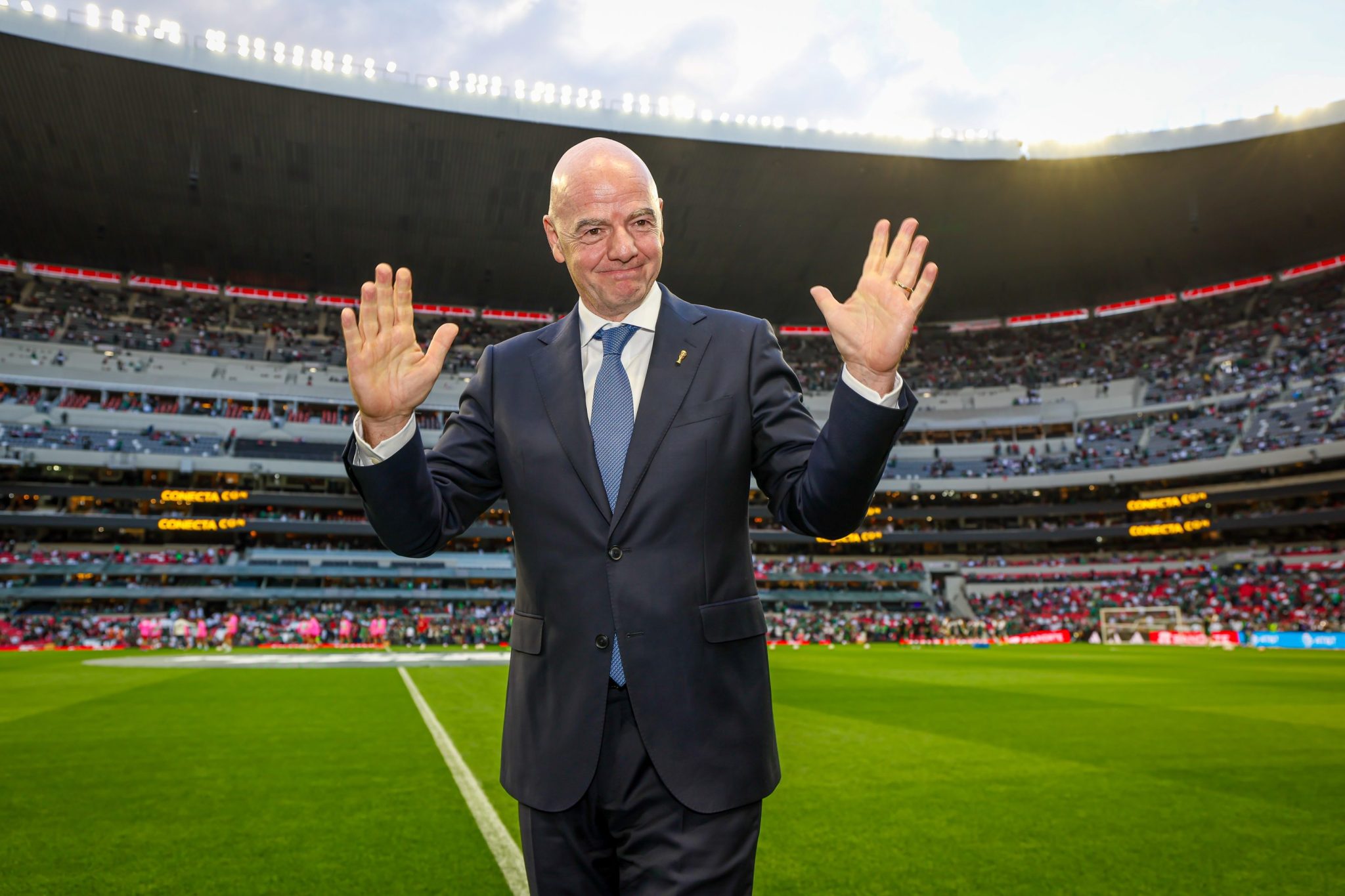
A decade later, Infantino, now 56, is at the center of the biggest stage of all: this summer’s World Cup, which kicks off in Mexico City on June 11 and closes in New Jersey on July 19 after 39 days of games across the U.S., Mexico, and Canada. For FIFA’s president, a lot is riding on whether the Cup’s viral energy can finally make soccer a major sport in the U.S., on par with baseball or (American) football, once the stadiums have emptied.
On many levels, this is Infantino’s World Cup—promoted by him for years, with relentless expansion and an assiduous courtship of host-in-chief, President Trump. Infantino attended Trump’s second inauguration and his Gaza peace summit in Egypt, and at the Kennedy Center in Washington in December, he handed Trump a new “FIFA Peace Prize.”
Few question Infantino’s accomplishment in pulling off this summer’s gargantuan event, and his detractors do not allege malfeasance. Yet his success is not without controversy, as sky-high ticket prices and enormous costs to taxpayers undercut the value of playing host. What’s more, complaints about FIFA before Infantino became president—that the organization and its leader had far too tight a grip over the sport—have not abated. FIFA, which declined to grant interviews with Infantino and other officials, told Fortune in an email that it had “implemented extensive reforms and taken concrete steps to regain its reputation as a credible institution” since 2016. But the criticisms remain. FIFA is “almost too big to fail or too big to pull apart,” says Bonita Mersiades, a former Australian soccer executive who helped expose FIFA’s corruption in the 2000s. Overhauling the organization, she says, is “very, very difficult. Everybody wants their country to win the World Cup.”
In many respects, Infantino has amply fulfilled his 2016 promises. This year’s Cup is vastly larger than the 2022 tournament in Qatar. There are 48 countries competing, up from 32; they’ll play 104 matches (up from 64), across 16 cities—in three countries, a first for FIFA. Infantino also expanded the Club World Cup, made up of professional teams, from seven to 32 clubs, which competed across the U.S. last year. That Cup delivered a $2 billion boost to FIFA revenues, netting Infantino a 33% bump in his bonus; his total annual compensation package is an estimated $6 million.
As notable as this Cup’s outsize scale is the outsize money. It is set to be the biggest sporting event in history, with predicted revenues of about $8.9 billion—about double the 2024 Paris Olympics earnings. Of that, $3.9 billion will come from broadcasting rights; $3 billion from ticketing and hospitality; and $1.8 billion from sponsorship deals. Sponsors pay millions to plug their brand around stadiums: Good luck trying to drink Pepsi, rather than Coca-Cola, during a match. “There are very few things like the World Cup,” says Ricardo Fort, head of sponsorship-deal consultancy Sport by Fort, which negotiated World Cup deals this year for AB InBev and Airbnb. For companies wanting increased visibility, the event is invaluable, he says: “There are fans everywhere. It is a great tool to become global.”
104/48
Number of matches and teams on the Cup schedule, up from 64 and 32 in 2022.
$8.9 billion
Forecast revenue for the Cup—roughly double what the 2024 Olympics earned.
FIFA’s revenues could rise 73% from its previous four-year budget cycle, which ran from 2019 to 2023—and about double the revenue in the cycle before Infantino became president. The proportion reinvested into the sport has risen sevenfold, to a total of about $5 billion since 2016, FIFA says.
FIFA is organized as a nonprofit, but its financial power belies that label. Unlike other sporting bodies, FIFA earns most of its money from just one event—the men’s World Cup—whose singular prestige gives FIFA, and Infantino, exceptional control over the sport.
The system is one of patronage: FIFA associations, one in almost every country, receive payouts—up to $8 million each in the four-year cycle that began in 2023—to develop the sport, under the “FIFA Forward” system that Infantino implemented a decade ago. Much of that goes to poorer countries to help them train players or build stadiums. This Cup’s debut competitors—Jordan, Uzbekistan, Curaçao, and Cabo Verde—have benefited hugely, FIFA says. In all, FIFA expects to pay each of the 48 competing teams at least $12.5 million.
The result is a vertical integration between FIFA and global soccer that’s hard to challenge. When 12 rich clubs tried to form a breakaway “European Super League” in 2021, Infantino told them, “You’re in or you’re out.” The idea collapsed: No player dared risk being ousted from the World Cup.
In Infantino’s telling, FIFA could maintain its recent growth—if it conquers North America. “The global soccer GDP is around $300 billion a year,” he told investors at the Milken Institute’s Global Conference in Los Angeles in May. Of that, he noted, 70% is generated from Europe’s mammoth industry, while U.S. soccer accounts for a minuscule 3%. “This is a message to all investors here,” he said. “If the United States was doing 30% of what Europe does…you’re speaking about a $100-billion-a-year impact.” Infantino claims FIFA received 500 million requests for the 7 million World Cup tickets on offer.
Even so, success hasn’t erased discontent. Critics tell Fortune that FIFA’s rocketing growth has quelled internal debate, with deep reluctance to challenge Infantino’s decisions. One discomfort is Infantino’s close ties to leaders like Qatar’s royals and Saudi Crown Prince Mohammed bin Salman. In late 2024, Saudi Arabia clinched rights to the 2034 World Cup, as the sole bidder, after FIFA broke with precedent by announcing that its members would have to choose the 2030 and 2034 hosts at the same meeting, with yes/no votes required for both. That left only Saudi Arabia—a major backer of FIFA—with a ready-made bid for the later event.
“If the United States was doing 30% of what Europe does [in football] you’re speaking about a $100-billion-a-year impact”
Gianni Infantino, FIFA president, addressing the Milken Institute’s Global Conference
FIFA points out that under Infantino, all 211 member countries—not just FIFA executives—vote for World Cup hosts. But detractors say that voting system makes it even harder to overhaul FIFA from within. In his new book, FIFA Connection: Inquiry Into the Infantino System, a blistering takedown of the organization, French soccer journalist Simon Bolle describes a system of fealty, built on FIFA disbursing funds to its national associations—each of which has one vote for FIFA president, whether giant China or tiny Samoa. With small nations dependent on FIFA funds, the system is self-perpetuating. “Today, the first criterion of this global body is money,” Bolle writes, “and the president does not even try to hide it.”
In retrospect, FIFA could have taken another route. In the fallout after the 2015 scandal, the organization created new ethics and oversight groups, and the powerhouse soccer countries in Europe considered trying to break FIFA’s grip on the professional sport.
“At that moment in time, there was an opening,” says Miguel Poiares Maduro, a Portuguese jurist and academic, who was appointed to head FIFA’s new independent governance committee after the scandal, to enforce issues around due diligence and political neutrality.
Maduro did not last long: FIFA fired him and two of his committee members in 2017, after months of wrangling. In their telling, FIFA’s leaders did not want public accountability. “FIFA basically operates as a political cartel, with a high concentration of power in the president,” Maduro tells Fortune. “Ultimately, he ends up determining who operates at every level of football.” This May, Infantino announced he would stand for a third four-year term next year—a pro forma election where the president is expected to face no rival.
There have been complaints aplenty heading into the summer—and for World Cup host cities, the pain may have only just begun. Under FIFA’s contracts—signed in 2018, before most current mayors and governors were elected—hosts must shoulder costs that run to tens of millions, including for security required by FIFA. Dynamic pricing has sent some ticket prices into the stratosphere, with FIFA pocketing most of the money. And in May, about 80% of American hotels surveyed said World Cup bookings were below expectations.
The kinetic excitement of the tournament could well silence the grumbling. For the players themselves, vying for the Cup is a life’s dream; as veteran soccer writer Simon Kuper, author of the new book World Cup Fever, says, “It is the first line in their obituary.” But what of the uniquely grassroots quality of soccer? To some aficionados, that seems lost amid the massive sponsorship deals.
I saw the sport’s rags-to-riches possibility up close in 2018, when I spent days inside Barcelona’s world-famous soccer club for Fortune. One night, I stood watching the youth trainees and asked the coach whether anyone could be the next Lionel Messi. He pointed to a skinny 10-year-old boy darting across the pitch, the son of modest-income African immigrants. “Of course, you can’t tell,” he told me. “He could be injured, or puberty could change things.” I wrote his name in my notebook, on the slim chance he one day turned pro. Years later, I checked his name in my notes: Lamine Yamal. Now 18, Yamal is set to earn up to $46 million this year, and is Spain’s superstar in the World Cup (though an injury could bench him in the early games). As one of FIFA’s biggest global phenomenons, Yamal is the stuff of which Infantino’s dreams are made.
This article appears in the June/July 2026 issue of Fortune with the headline “Has the World Cup made FIFA too big to fail?”
This story was originally featured on Fortune.com