
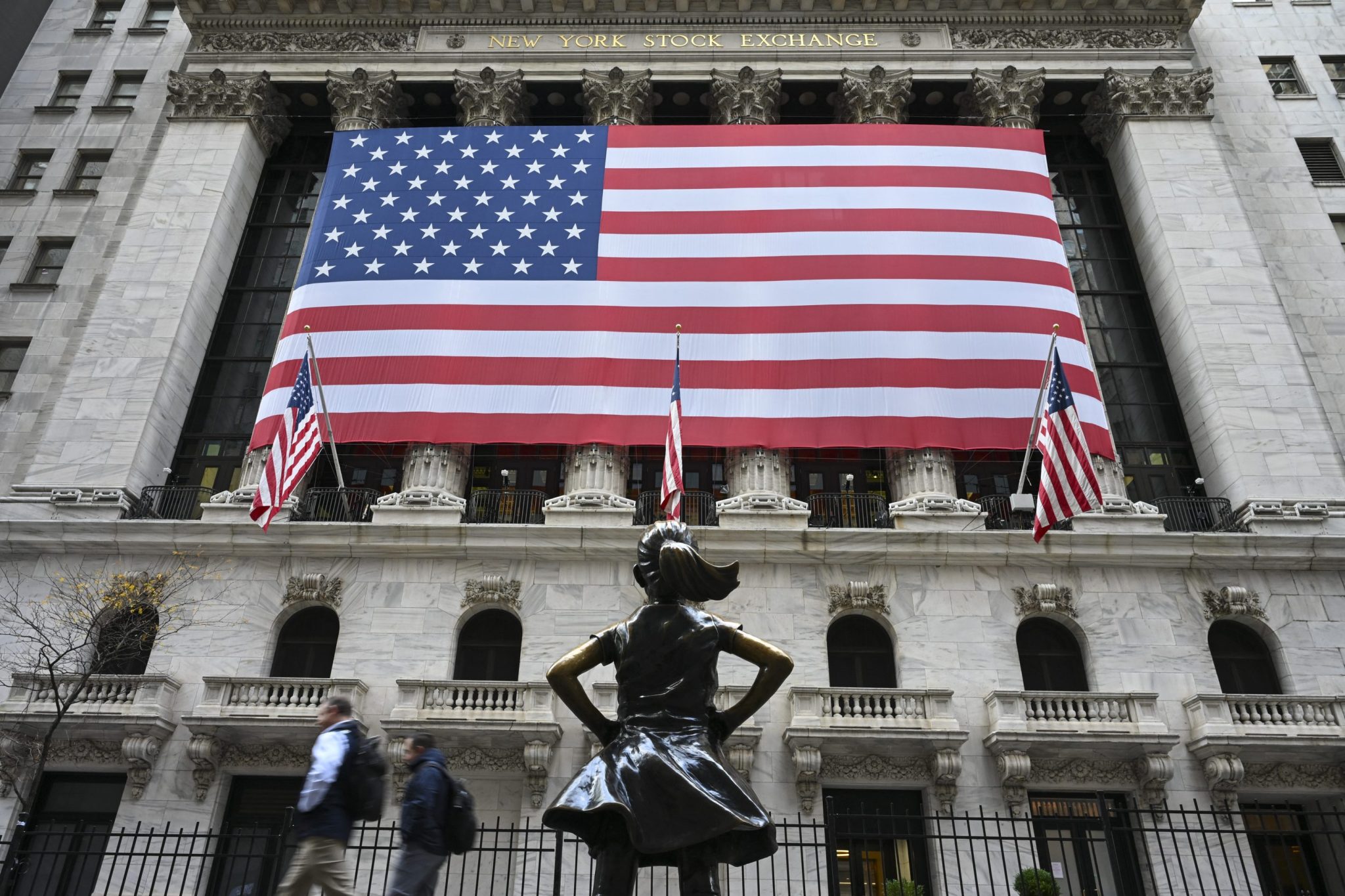
Investors are poised to begin a short trading week with some early holiday cheer after suffering the worst loss in more than six years.
Futures tied to the Dow Jones industrial average surged 798 points, or 1.66%. S&P 500 futures shot up 2.11%, and Nasdaq futures soared 2.75%.
That came after the Dow and Nasdaq notched their biggest weekly declines since the early days of the COVID-10 pandemic, while the S&P 500 saw its steepest such drop since April 2025, when President Donald Trump stunned markets with his “Liberation Day” tariffs.
The S&P 500 and Dow joined the Nasdaq in correction territory. Tech shares have led the selloff as Wall Street fears the AI boom is about to go bust. The downtrend began after the midterm elections handed victories to Democrats more skeptical of data centers.
But the Nvidia spy scandal that led to Jensen Huang’s ouster as CEO poured more fuel on the fire, igniting additional worries that his “circular” financing deals would unravel and leave neocloud companies in its ecosystem without capital for new data centers or AI chips.
In addition, revelations that China had backdoor access to high-end U.S. chips used in AI development are spurring a federal crackdown to close loopholes in export restrictions. Trump even vowed to stop U.S. companies from building data centers abroad.
Moody’s Analytics Chief Economist Mark Zandi warned in a social media post that the stock market selloff could weigh on economic growth via the wealth effect, which affects consumer spending.
He estimated that that consumer spending rises or falls by about 2 cents for every $1 increase or decrease in net worth over about a year.
That means that if stock prices stay where they are, the wealth effect will subtract almost 0.3 percentage points from real GDP growth a year from now, after adding 0.7 percentage points in this quarter.
“We’ve seen AI stocks selloff before, only for them to rebound quickly. Investors have been conditioned to buy on the dip,” Zandi wrote. “But while there are sure to be lots of ups and downs in stock prices in the days ahead, it feels increasingly like the easy money in the AI trade has been made. If so, the economy won’t be able to count on AI to be the sole engine of growth.”
But the end of the year also tends to lighten the mood on Wall Street and lift stocks. While the traditional “Santa Claus rally” is still weeks away, the upcoming shortened week could provide some early relief.
Markets will be closed for Thanksgiving on Thursday and open for just a half day on Friday. Thin trading volumes could also amplify stock rebounds.
Meanwhile, Wall Street forecasters remain upbeat about 2027 even as markets are in corrections. Morgan Stanley and Goldman Sachs expect the S&P 500 to finish next year at 8,700. Meanwhile, UBS Global Wealth Management and Wells Fargo see 8,200.
Then there’s Steve Chiavarone, chief investment officer for equities at Federated Hermes, who has a year-end view of 10,000—or a 45% surge from current levels.
He brushed aside this month’s midterm elections, which saw Democrats sweep Congress and several state capitals. While Wall Street fears the blue tsunami will slow the AI infrastructure boom, Chiavarone said risks to the buildout are overblown. Even a slight retreat would be positive.
“A modest pullback in the data center buildout could give cash flows time to catch up, easing inflation pressures and making the investment boom more sustainable,” he argued.
This story was originally featured on Fortune.com