
Alphabet is spending roughly $200 billion this year to build out its AI capacity, and the company’s president and chief investment officer reiterated Google’s plan next year for the bill to be even more substantial.
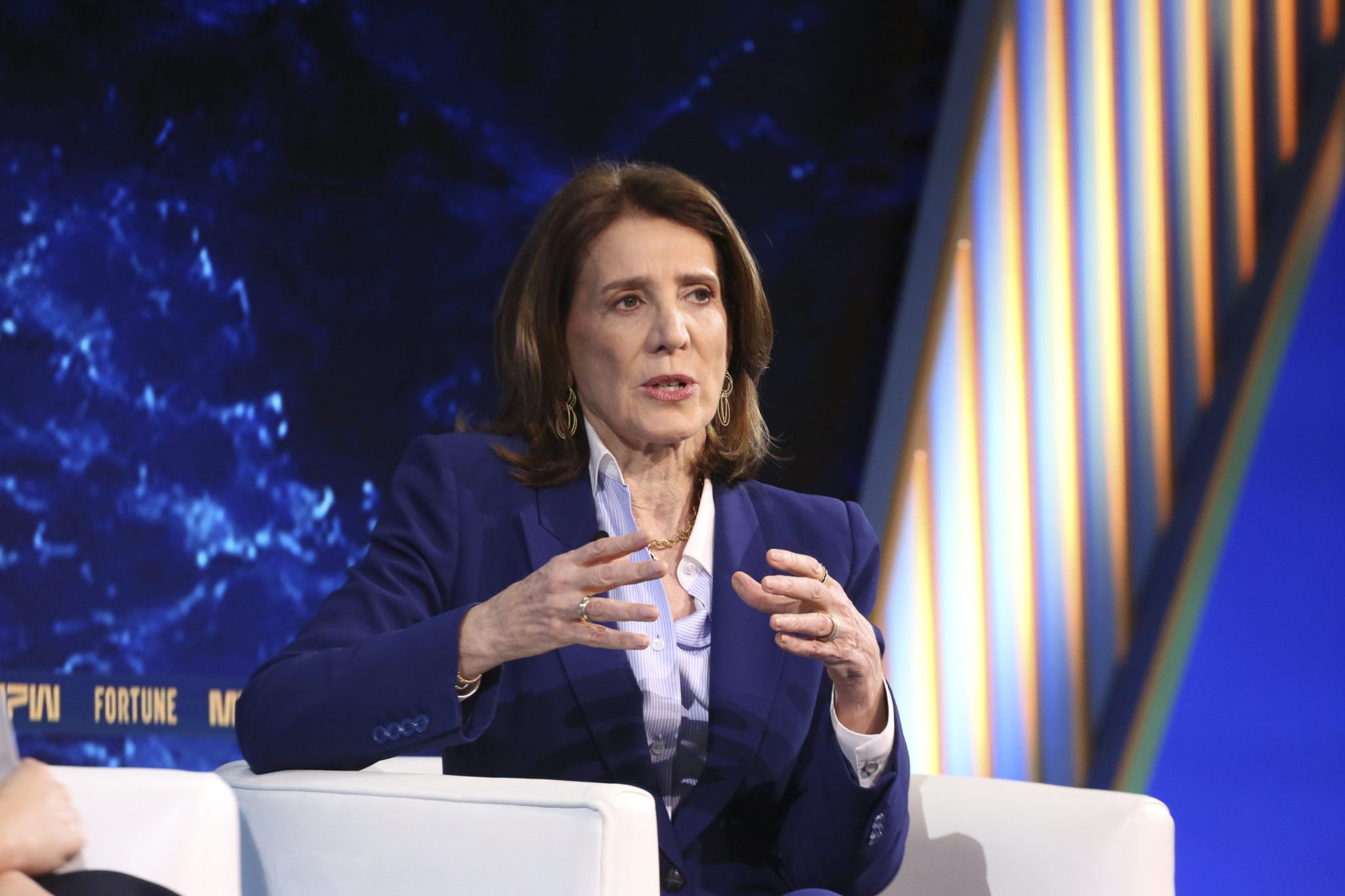
Alphabet expects capital expenditures (capex) to “increase significantly” next year, Ruth Porat said Monday at Fortune’s Most Powerful Women Summit in Santa Barbara, Calif., adding that the company remains “capacity constrained” as demand for compute grows.
“The demand for compute—because of the value that our partners are seeing in the enterprise, in governments, what we’re seeing across our platform—suggests that we’re in the buildout here now,” she told Fortune Editor-in-Chief Alyson Shontell. When pressed as to where exactly the industry is in the long term timeline of funding the AI building, and if we are in the peak of spending, Porat replied, “We do see this as an opportunity that extends for quite some time.”
Porat, No. 11 on Fortune’s 2026 Most Powerful Women list, is shepherding one of the largest corporate spending sprees ever. Before taking her current role in 2023, she spent nearly a decade as Alphabet’s finance chief, and before that she was Morgan Stanley’s CFO. Porat oversees Alphabet’s investment vehicles, including its capital arms GV and CapitalG, as well as its “Other Bets” ventures, and real estate investments.
In July, Alphabet lifted its 2026 capex outlook to as much as $205 billion, and the stock dropped more than 6% the following day, a sign of how hard Wall Street is pushing for proof the massive spending will pay off for investors. The AI spending is already reshaping Alphabet’s finances. Capital expenditures hit $44.9 billion in the second quarter, “with the vast majority of this spent in technical infrastructure to support our investments in AI,” Alphabet CFO Anat Ashkenazi said during the company’s Q2 earnings call. That pushed free cash flow to negative $5.9 billion, the first time Alphabet’s quarterly cash flow had dipped below zero in its more than 20 years as a public company. Meanwhile, Google Cloud’s revenue climbed 82% to $24.8 billion, while its operating profit more than tripled to $8.8 billion.
Shontell questioned Porat about a recent report from Jefferies global head of equity strategy Chris Wood, who argued the AI boom will most likely end in massive capital destruction in the U.S. as cheaper open-source Chinese models take market share. Porat disagreed.
“It’s illogical to say that we’re in a capacity-constrained position because there’s such strong demand for the insight and the ability to improve business and government, and yet you can’t drive a return on it,” she told Fortune.
To earn an attractive return, Porat said, companies need to focus on two things: “One, what is the value that we add to partners so that you can actually deliver attractive revenue growth, and the other is how efficiently do we deliver that compute capacity.”
When asked what winning looks like for Alphabet, Porat pointed to responsible deployment rather than ranking who is best.
“The thing that is true throughout history is anything that is not built for the long run won’t endure for the long run,” Porat said. She noted that Alphabet’s capex spending is itself a payoff from strategy devised years ago, starting with Google’s 2016 pivot from “mobile first” to “AI first.”
“You must invest for long-term growth,” she added. “By the time you need it, it’s too late.”
Porat has repeatedly made the bullish case for AI’s payoff. At an Economic Club of New York event in June, Porat called data centers a “job creator,” Fortune’s Most Powerful Women Editor Emma Hinchliffe wrote. She also argued data centers have helped slow energy price growth by spreading fixed costs across a larger base. And at Fortune’s Global Forum in Riyadh last year, she described AI as “so much more than a chatbot,” and said “we should be able to cure cancer in our lifetime.”
To be sure, Porat acknowledged growing resistance to data centers, saying about 71% of Americans don’t want one built in their community, in line with a recent Gallup poll. But she argued that opinion shifts when companies add energy capacity, protect affordability, and create local jobs. She pointed to Google’s investments in nuclear, geothermal, solar, and wind, and to a Skilled Trades Alliance that Google cofounded with Ford, BlackRock, and Carhartt to train electricians, welders, and other workers the buildout needs.
“We have to solve the downside anxiety. It’s real. It’s substantive,” Porat said. “That’s why I say, if we can [build AI], we must.”
Porat has the veteran finance experience to help forge ahead.
During the 2008 financial crisis, she worked closely with then-Treasury Secretary Hank Paulson, leading the Morgan Stanley team that advised the Treasury Department on Fannie Mae and Freddie Mac and the New York Federal Reserve on AIG. The key lesson from that crisis, she said Monday, was to “identify your greatest source of vulnerability early and fortify against it, because you can’t address it in the moment.”
For companies today, she said, that vulnerability is falling behind on AI.
“Because if anyone is connecting with your customers in ways that you are not … You’re at a competitive disadvantage.”
This story was originally featured on Fortune.com