
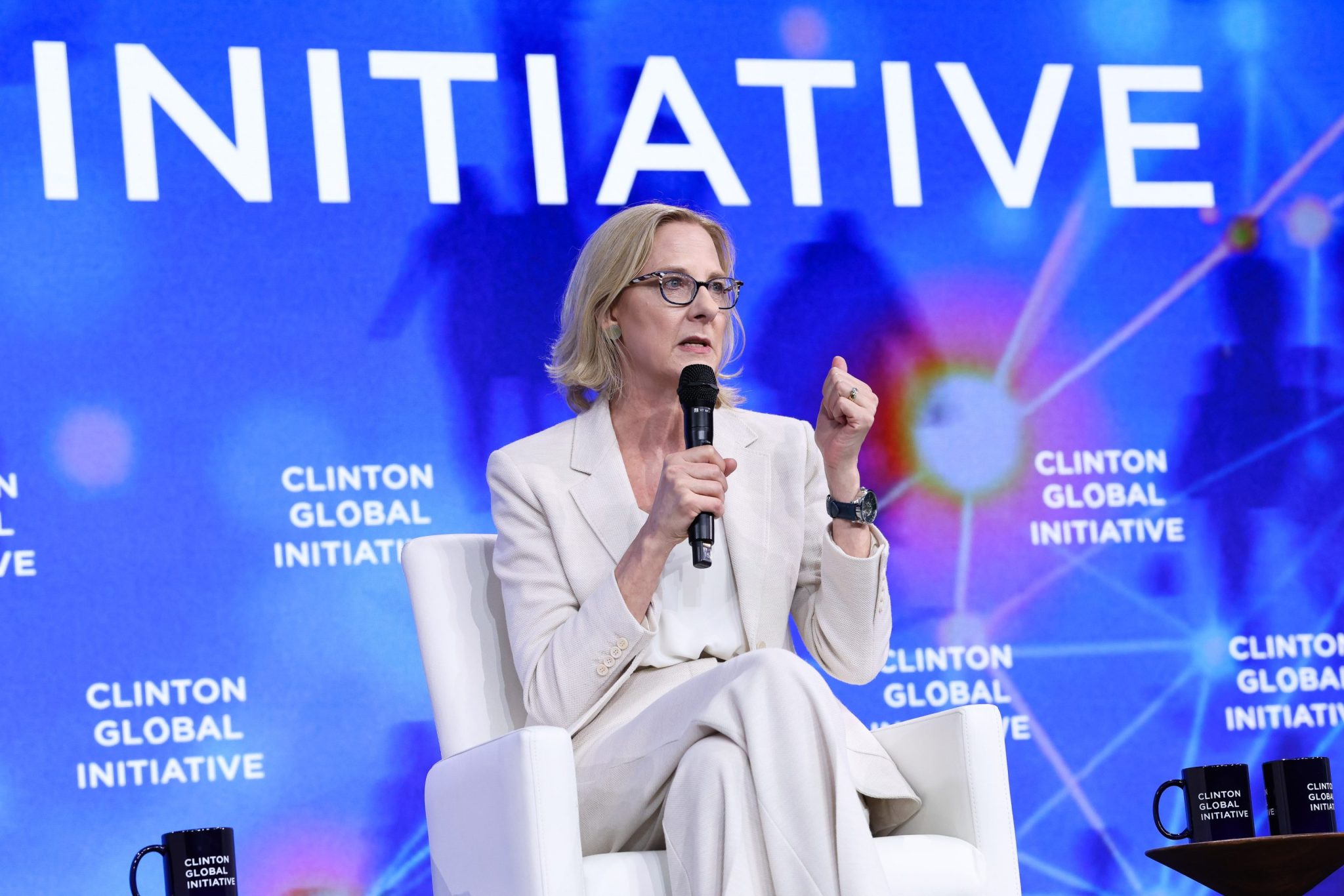
Less than a year after leaving Yale Law School to run one of the wealthiest private foundations in the U.S., Heather Gerken is putting her stamp on the Ford Foundation and its $18 billion endowment.
The Ford Foundation on Thursday laid out a new strategy that reorients the 90-year-old grantmaker around what it calls the “preconditions for thriving democracies,” from the rule of law to trustworthy information and inclusive economies. Some have considered it the Ford Foundation’s most significant strategic shift since 2015, when former president Darren Walker focused the foundation around fighting inequality.
The announcement also lands less than two weeks before the midterm elections.
“The Ford Foundation’s new vision is an evolution, not a revolution, of our work, and a reflection of this era’s rapidly changing global landscape,” Gerken said in a statement.
Despite the name, the foundation operates independently of Ford Motor Company. Edsel Ford (Henry Ford’s son) started the foundation in 1936 with $25,000, and from the start it was meant to stand apart from the car company. When Edsel died in 1943 and Henry Ford in 1947, the money they left vaulted the Ford Foundation to the top of the world’s foundations, according to a 2024 Fortune commentary co-written by Walker.
Henry Ford II, Edsel’s son, later steered the foundation toward independence. The foundation took on a global mission, added trustees from outside the family, relocated to New York City in 1953, and ultimately sold its stake in the automaker, the foundation has said. Ford Motor Company has its own charitable arm, Ford Philanthropy, which is funded by the company’s earnings.
Today, the Ford Foundation is headquartered in New York, runs 10 offices overseas, and funds more than 2,300 grantees. Its endowment has grown from $13 billion in 2019, when it was giving away more than $600 million a year, to $18 billion now, according to the foundation. Historically, the Ford Foundation supported civil rights lawsuits beginning in the late 1960s and helped build public interest law into a field of its own.
Fighting autocracy and inequality
The Ford Foundation frames its new plan as its answer to rising autocracy, widening inequality, and fading public trust.
“Conditions have changed since our last strategy review, and we are marshaling all of our resources to respond to these new challenges while staying true to our legacy as a social justice foundation,” Gerken said in a statement.
The foundation expects to award about $700 million in grants in 2027, a figure that could rise, a Ford Foundation spokesperson told the Associated Press. The organization is also changing how it hands out that money. It says it will make bigger grants, commit more money over multiple years, and expand general operating support. The foundation cites decades of research and learning showing that grantees with flexible, long-term funding were better prepared for the unexpected.
“Throughout the strategy review process, it became abundantly clear that this unpredictable and volatile period requires much from philanthropy,” Nicholas Turner, Ford Foundation’s executive vice president of programs, said in a statement.
Grantmaking will now run through seven funding areas: democratic governance and the rule of law, inclusive economies, information as a public good, safety and justice, gender equality, global cooperation, and racial justice. It will roll out strategies for each in stages throughout 2027.
The foundation will also create a dedicated racial justice fund. Its gender equality work will also expand to include the entire range of reproductive health care, and its information work will try to influence how digital tools get built, rolled out, and overseen.
The shift will cost some current grantees their funding. The foundation will eventually wind down certain programs, but Turner told the AP it was “too early to say” which would be affected. He promised the foundation would leave those areas “with respect and grace and care and support.”
The foundation’s pivot comes as the Trump administration ramps up pressure on nonprofits. President Donald Trump threatened last year to revoke Harvard University’s tax-exempt status, and earlier this month the administration proposed a rule that would strip colleges and private schools of that status if they run race-based programs, the Chronicle of Philanthropy reported. Vice President JD Vance, while running for Senate in 2021, argued that major foundations should lose their tax exemptions and called the Ford Foundation and others like it “cancers on American society.”
Gerken stressed to AP that her organization’s democracy work is nonpartisan, pointing to the millions of dollars the Ford Foundation has put toward groups defending election results this year.
“Our commitment to social justice and to communities that have been pushed to the margins, denied equal justice or economic opportunity, will remain a throughline across all of our areas of work,” Gerken said in a statement.
This story was originally featured on Fortune.com