

Ever since Google was founded in 1998, search has been the core of the company’s identity. For much of that time, search has also been the engine (no pun intended) driving Google’s business.
On Wednesday, that began to change.
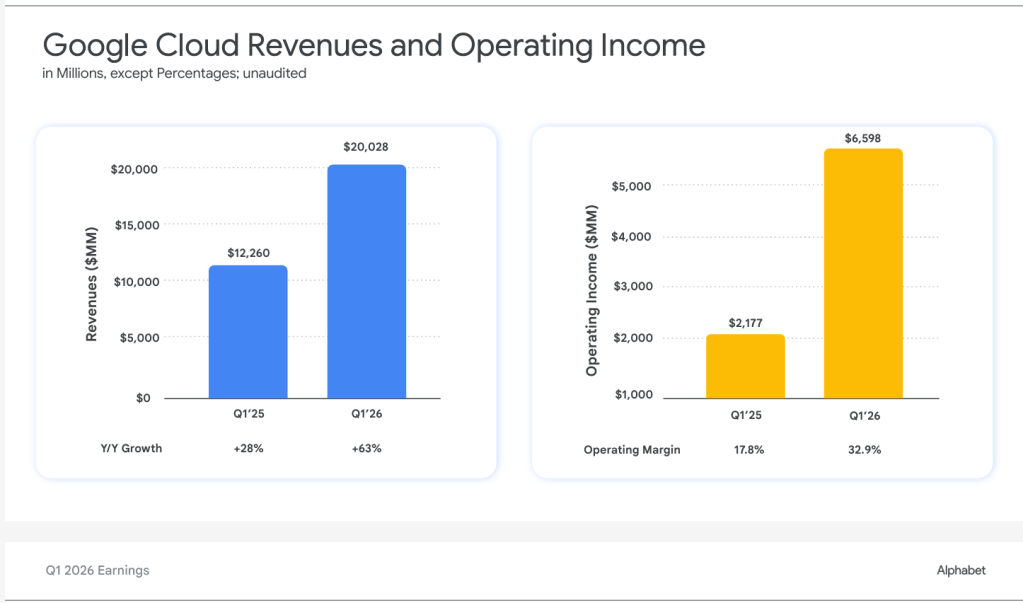
The company’s cloud computing business was the undisputed star of parent company Alphabet’s first-quarter earnings, posting an eye-popping 63% revenue growth from the prior year, for a total of $20 billion.
AI is of course what’s driving the booming growth in the Google Cloud business, as CEO Sundar Pichai and other company executives noted on the earnings call. And investors were delighted, sending shares of Alphabet up 7% in after hours trading.
But lost in the excitement of the moment is something more fundamental: Google Cloud now represents 18% of the company’s overall business. It’s perhaps just one quarter or two more quarters away from comprising one-fifth of the Google empire—something that would have been unthinkable a few years ago.
At this time last year, Google Cloud represented 13.6% percent of Alphabet’s total revenue. In the first quarter of 2024, Cloud was just 11.8%.
Advertising has always been the center of gravity for Google, with its high-margin and recession-proof search ads at the top of a mountain that includes YouTube video ads, display ads that Google distributes to other sites, and ads that appear in Google’s portfolio of popular properties like Gmail and Maps.
It’s not that Google’s ads business is in any danger of going away. Ads generated $77 billion in the first three months of the year, up roughly 16% year-over-year. That’s more revenue than American Express generated in all of 2025. And many Google-watchers believe that AI will only enhance the company’s capacity to serve ads to searchers.
But the cloud business has reached an inflection point where it’s no longer just a cute sideshow. In addition to the revenue growth, Google’s cloud’s operating income tripled from the year-ago period to $6.6 billion. More impressive still, the cloud business operating margin expanded from 9.4% a year ago to 32.9% in Q1.
The blooming of the cloud business is likely to have a significant impact at Google beyond the income statement. The cloud business is run by enterprise sales people in suits like Cloud boss Thomas Kurian, an Oracle veteran. It’s a completely different culture than the rest of Google, where sandal-wearing engineers, product managers, and media types set the tone. How that cultural contrast plays out inside the company in the quarters and years ahead will be fascinating to watch, especially when the time comes to choose a successor to Alphabet CEO Sundar Pichai.
Of course, the main factor that will determine how big the Cloud business becomes is AI. Right now, customer demand for AI is insatiable (Google Cloud’s current backlog is $460 billion) and Google’s cloud business is rising along with it. If the AI train suddenly comes to a halt, or even slows—which many observers think could happen—Google’s cloud business could find itself back in second class.
This story was originally featured on Fortune.com